
How to Store and Conserve an Airless Sprayer Between Jobs
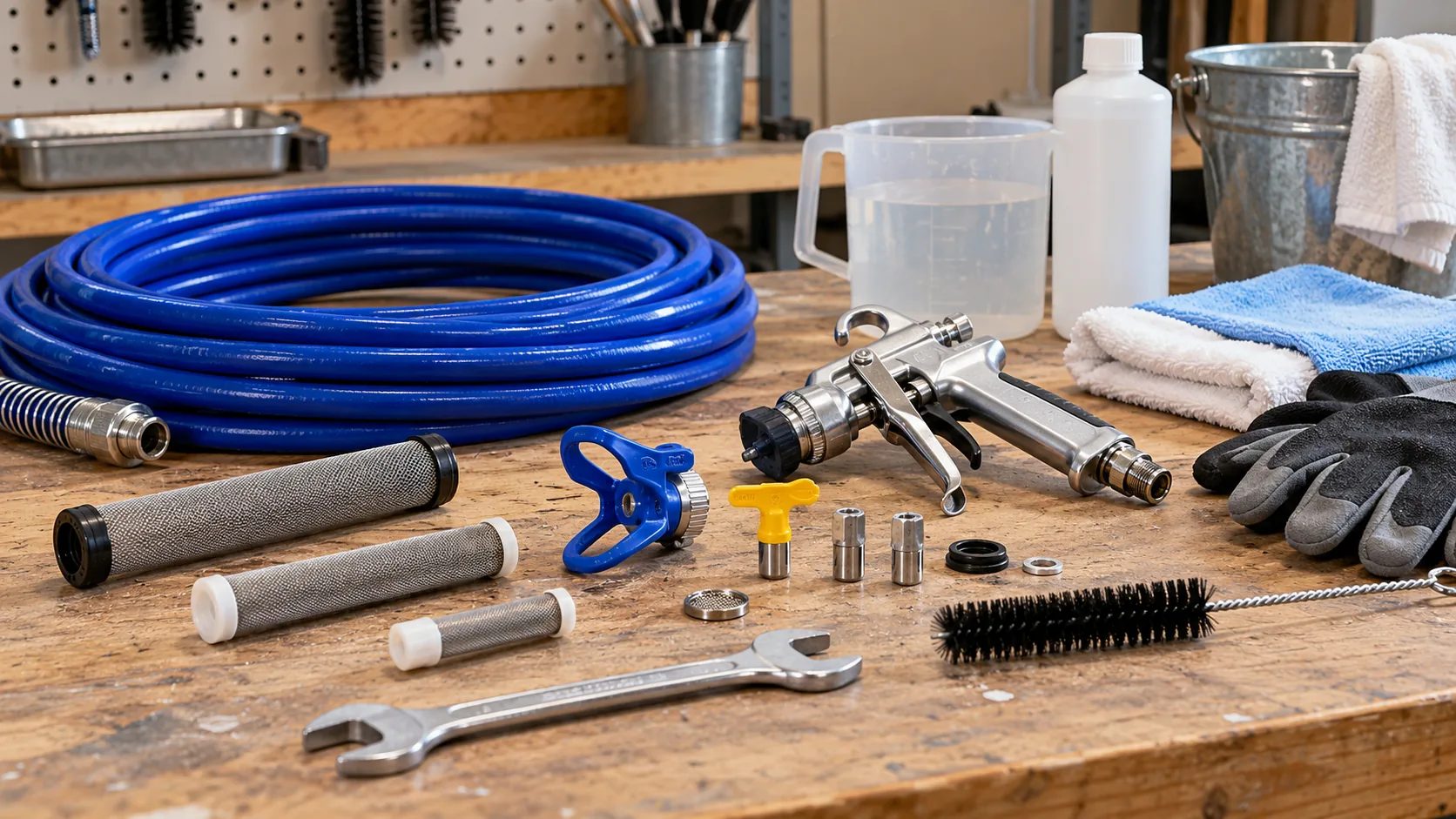
Most airless pump failures do not happen while spraying — they happen in storage. Paint left to dry inside the pump, packings that dry out, or water that freezes over winter quietly ruin a machine between jobs. A few minutes of conservation when you put the sprayer away saves a long repair when you next need it.
First: flush it properly
Storage starts with cleaning. Pump the remaining material back into the tub, then flush the whole system — pump, hose, gun and tip — with the right solvent (water for water-based materials, the recommended solvent otherwise) until it runs completely clear. Clean the tip, the gun filter and the suction filter separately. Any material left inside will dry and harden, and that is what wrecks pumps.
Conserve the pump with storage fluid
Water left in the pump invites corrosion and lets the packings dry out. After flushing, draw a dedicated pump storage fluid (often called a pump conserver or, by its common abbreviation, a throat-seal/storage fluid) through the system so it coats the internal surfaces and keeps the packings supple. This is the single most effective step for a machine that will sit for more than a few days — overnight, over a weekend, or over winter.
Protect against frost
This matters most for water-based work and unheated storage. Water expands as it freezes, and water trapped in the pump, hose or gun can crack components. Either store the machine somewhere frost-free, or make sure no plain water is left inside — a pump storage fluid displaces it and protects against freezing at the same time. Never store a sprayer with water sitting in it through a cold spell.
Relieve pressure and park it safely
- Release the pressure, engage the trigger lock and set the prime/spray valve as the manual directs before storing.
- Remove the tip, clean it and store it separately so it cannot clog or get damaged.
- Coil the hose loosely without sharp kinks; a kinked hose takes a set and weakens.
- Store the machine upright, clean and dry, out of direct sun and away from frost.
Longer-term and winter storage
For a season-long break, conservation is not optional. Flush, draw storage fluid through, remove and store the tip, relieve the pressure and keep the machine frost-free. It is worth replacing tired filters now rather than discovering them on the first job of the next season — keep spare filters and wear parts and a service kit on hand so recommissioning is quick.
Getting it running again
When you take the machine back out, flush the storage fluid out of the system before you spray — pump clean solvent or water through until the fluid is gone, so it does not contaminate the first coat. Check the filters, fit a clean tip, prime the pump and run a test pass on scrap before the wall. If priming is slow or the pattern is poor after storage, our troubleshooting guide walks through the usual causes.
Frequently asked questions
Can I leave water in an airless sprayer overnight?
For a single night in a frost-free, heated space it is usually fine, though a pump storage fluid is still better. For anything longer, or in an unheated space, do not leave plain water in the machine — it invites corrosion and freezing. Flush and conserve instead.
What is pump storage fluid and do I need it?
It is a fluid drawn through the pump after cleaning to coat internal surfaces, keep the packings supple and displace water. For any break longer than a day — especially over winter — it is the most effective way to protect the pump.
How do I winterise an airless sprayer?
Flush it clean, draw pump storage fluid through, remove and store the tip, relieve the pressure and keep it somewhere frost-free. Make sure no plain water is left inside. Flush the storage fluid out again before the first spray next season.
Conclusion
A sprayer is only as reliable as the way it was put away. Flush it clean, conserve the pump, protect it from frost and relieve the pressure — and whether the break is one night or one winter, the machine starts clean and ready on the next job instead of in the repair queue.