Airless Sprayer Power Requirements: 230V, Generators and Extension Cables
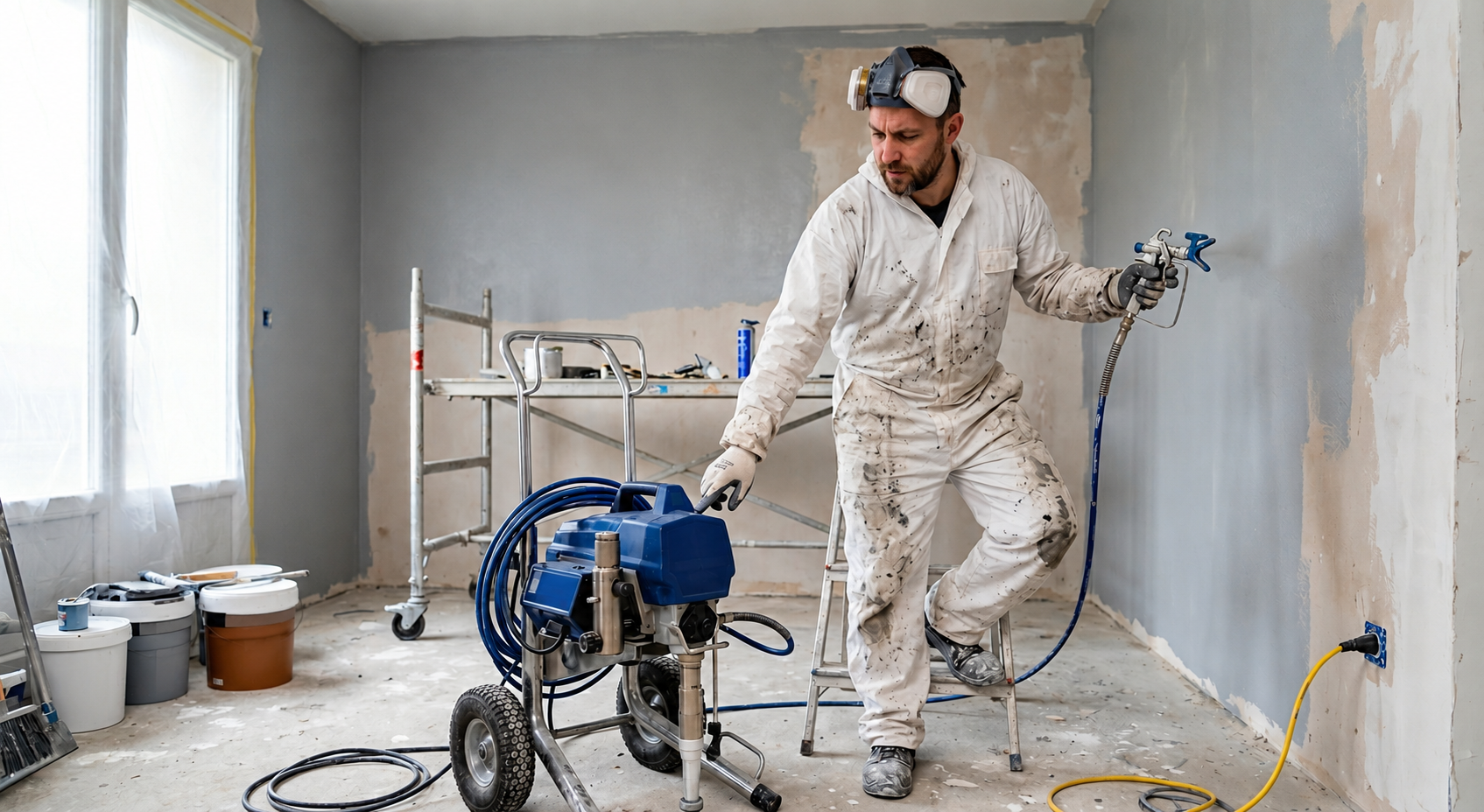
An electric airless sprayer is only as reliable as the power feeding it. Weak site power, a long thin cable, or an undersized generator will make a perfectly good machine stall, under-pressurise or trip — and it usually happens mid-wall. This guide covers what a professional electric sprayer actually asks of your supply, how to choose a generator, how to avoid voltage drop in your cables, and a quick pre-spray checklist. Where real GROG motor figures help, we use them as examples, and we are explicit about what you should confirm on your own machine's rating plate rather than guess.
Why power supply matters
Pressure and flow get all the attention, but on site the supply is what quietly decides whether the machine performs. An electric motor that cannot draw clean, stable power will not build or hold pressure — so the finish suffers for a reason that has nothing to do with the tip or the paint. Getting the power right is the cheapest reliability upgrade you can make.
What an electric airless sprayer needs from the supply
Professional electric airless sprayers run on single-phase 230 V site power; the largest units may be three-phase, so check the plate. The number that matters for power planning is the motor's power draw in watts, shown on the rating plate. Across the GROG electric range, verified motor power runs from about 1,000 W on the compact GR-390 and GR-490, through mid-range machines around 3,000 to 4,200 W such as the GR-650, F4L and AZ700, up to 5,500 W on the F5. More flow and heavier materials generally mean a bigger motor and a higher draw.
Always read your machine's rating plate for its exact voltage, wattage and current. Treat the figures here as range examples, not a substitute for the plate.
230 V requirements and startup demand
There are two numbers, and the second is the one that catches people out. The running load is the steady draw while spraying, which roughly tracks the rated watts. The startup or inrush is different: electric sprayer motors pull a much higher current for a moment at start-up, and again while the pump builds pressure. Your supply has to cover that inrush spike, not just the running watts. This is exactly why a machine can run fine on a wall socket and then refuse to start on a marginal generator or a long cable.
Extension cable basics
A cable that is too long or too thin drops voltage before it reaches the machine, starving the motor exactly when the inrush is highest. Plug directly into a wall socket where possible. If an extension is unavoidable, use a 3 x 2.5 mm2 (about 13 AWG) cable and keep the run as short as you can, in the region of 20 to 30 metres maximum. Fully unroll the cable drum before switching on, because a coiled cable can overheat. Keep runs short, go heavier rather than lighter on the gauge, and never run a big sprayer down a thin household extension lead.
| Situation | Practical choice |
|---|---|
| Wall socket available | Plug in directly — best option |
| Short extension needed | 3 x 2.5 mm2 (about 13 AWG), keep it short |
| Longer run unavoidable | Step up the gauge; shorten the run; or move the generator closer |
| Cable on a drum | Unroll it completely before starting |
Generator considerations
Size a generator above the running load with clear headroom for the startup surge. As a sense of scale, a 230 V sprayer drawing around 7.5 A (roughly 1.7 kW running) is commonly paired with a generator of at least 3,000 W — well above the running load, leaving room for inrush. A rough rule of thumb for motor loads is to allow up to about 300% of the motor rating for starting; treat that as a conservative cross-check, not a fixed requirement.
- Prefer an inverter generator with clean, stable output — airless motors dislike sagging or dirty power.
- Size from your machine's rated watts, then add generous headroom; if the sprayer stalls on start-up or the pump hesitates, the generator or cable is too small.
- A bigger machine, for example a 5,500 W F5, needs a correspondingly larger generator than a 1,000 W compact unit.
- Confirm against your machine's plate and the generator's rated and surge watts. Do not derive a number from the pressure spec.
Typical mistakes on site
- Sizing a generator from the pressure spec instead of the wattage.
- Forgetting inrush and covering only the running watts.
- Using a long, thin extension lead, or leaving the cable coiled on the drum.
- No residual-current (RCD) protection on a wet, paint-covered site.
- Assuming all models draw the same — a 5,500 W machine is not a 1,000 W machine.
How to avoid power-related spraying problems
Most on-site power problems show the same symptoms: the machine will not start or trips at start-up, pressure is low or fluctuates, or the motor cuts out when the pump loads up. These point to voltage sag from an undersized generator or cable, or an inrush the supply cannot meet. A quick routine prevents nearly all of them.
- Read the rating plate: voltage, watts, amps.
- Confirm the supply or generator comfortably exceeds the running watts, with surge headroom.
- Prefer a wall socket; if not, use a 2.5 mm2 cable, a short run, fully unrolled.
- Check that RCD protection is present and tested.
- Dry-start the machine and build pressure before loading paint — confirm it holds.
- If it stalls or pressure sags, upsize the generator or cable before blaming the machine.
Conclusion
Match the supply to the machine, not the other way around. Read the rating plate, size your generator above the running watts with room for inrush, keep cables short, heavy and unrolled, and protect the circuit with an RCD. Do that and an electric airless sprayer is dependable all day; skip it and even the best machine will stall on site. When specifying a machine, check its motor wattage against the power you will realistically have — the compact GROG units ask little, the high-output models ask a lot more. Browse the GROG electric range to match a machine to your site power.