Choosing airless tips: which tip for which paint?

The tip is the smallest but most important part in airless spraying. It decides material output, fan width and surface quality — and therefore speed, material consumption and the final result. The wrong tip means streaks, mist and clogging; the right tip means fast, clean work. This guide explains the tip numbering system, how orifice, fan width and pressure relate, and shows in a clear table which tip suits which paint.
How an airless tip works
In airless spraying, material is forced — without compressed air, by high material pressure alone (up to around 227 bar on professional units) — through a very small opening, the tip orifice. The paint atomises into a fan-shaped jet. Two tip properties decide the result: the orifice size (how much material passes) and the spray angle / fan width (how wide the fan is). Both are encoded in the tip number.
Understanding the tip numbering system (e.g. 517, 519, 521, 621)
Common tips carry a three-digit number such as 411, 517, 519, 521 or 621. It is not a random code but encodes two values: the fan width and the orifice size.
The first digit: fan width and spray angle
The first digit indicates the fan width. Multiplied by two, it gives the approximate fan width in inches, measured at about 30 cm from the wall. A "5" gives roughly 10 inches (about 25 cm), a "6" about 12 inches (about 30 cm), a "4" about 8 inches (about 20 cm). The higher the first digit, the wider the fan and the larger the area covered per pass.
The last two digits: the orifice size
The last two digits give the orifice in thousandths of an inch. "17" means 0.017″, "21" means 0.021″. The orifice determines how much material exits per unit of time — and therefore how thick the material may be. So the number tells you everything important:
| Tip | Orifice | Fan width (approx.) | Typical use |
|---|---|---|---|
| 411 | 0.011″ | 20 cm | Lacquers, water-based lacquers, enamel |
| 517 | 0.017″ | 25 cm | Primer, wall paint |
| 519 | 0.019″ | 25 cm | Emulsion, primer |
| 521 | 0.021″ | 25 cm | Facade paint |
| 621 | 0.021″ | 30 cm | Facade paint, large areas |
Note: two tips can share the same orifice but different fan widths (e.g. 521 and 621, both 0.021″). The wider tip covers larger areas faster but demands a bit more from the unit and is harder to control on edges and details.
Orifice, material and viscosity
The central rule: the thicker (more viscous) the material, the larger the orifice needed. Thin materials such as stains and lacquers run cleanly with small orifices (0.008–0.013″); thick materials such as emulsion and facade paint need larger orifices (0.017–0.027″) so enough material passes and the fan stays closed. Too small a tip for thick material clogs and tears the pattern; too large a tip for thin material wastes paint and increases mist.
The orifice also affects throughput: larger tips deliver more litres per minute and therefore need a more capable unit. So tip choice and unit performance always go together — more on that in the GROG section below. The material's data sheet is always decisive: many paint makers state the recommended tip range and thinning directly.
Which tip for which paint? The selection table
The table below summarises proven orifice ranges by material. They are guide values — the exact tip depends on the specific product, the thinning and the unit. When in doubt, follow the manufacturer's data.
| Material | Recommended orifice | Note |
|---|---|---|
| Stains, glazes (thin) | 0.008–0.012″ | fine application, small fan |
| Lacquers, water-based, 2K, enamel | 0.011–0.015″ | fine finish, low pressure |
| Wood coatings | 0.011–0.015″ | thin to medium by viscosity |
| Primer / deep primer | 0.015–0.019″ | before the topcoat |
| Interior wall paint / emulsion / latex | 0.017–0.021″ | standard for walls and ceilings |
| Facade paint | 0.021–0.027″ | large areas, wide fan |
| Textured / protective coating (thick) | 0.025–0.035″+ | powerful unit required |
Practical rules of thumb: for lacquer and a fine finish, choose the smallest orifice that still gives a closed pattern — it saves material and reduces mist. For wall paint, 0.017–0.019″ is the all-rounder. For facade paint and large exterior areas, 0.021″ and a wide fan are fine. Thick textured and protective coatings need large orifices from 0.025″ — here the unit must supply enough pressure and flow.
Practical examples: the right tip for typical projects
Three typical situations from painting and renovation show how material, orifice and fan width work together:
- Repainting an empty flat (walls and ceilings, emulsion): a tip around 0.019″ with a wide fan (e.g. 519) covers large areas quickly and evenly. A narrower second tip pays off for edges and junctions.
- Spraying doors and frames (water-based lacquer): a small orifice around 0.011–0.013″ (e.g. 411) and a narrow fan give a fine, smooth finish at low pressure and little mist.
- Coating a facade (facade paint): a tip around 0.021″ with a wide fan (e.g. 521 or 621) puts enough material on the wall and keeps the pace up on large exterior areas.
In every case: set up on a test area first, check pressure and pattern, and only then move to the visible surface. This avoids costly corrections on the finished object — especially with high-grade lacquering and visible wall areas.
Choosing the fan width: area or detail
Fan width (the first digit) follows the task, not just the material. For large continuous areas such as walls, ceilings and facades, choose a wide fan (first digit 5 or 6) to move quickly. For narrow components, edges, reveals, doors and window frames, a narrow fan (first digit 2, 3 or 4) is easier to control and reduces overspray. Many pros keep two or three tips ready and switch by component.
Setting the pressure correctly
Set pressure as low as possible and as high as necessary: just high enough that the fan opens fully and evenly without visible streaks at the edges. Too much pressure creates unnecessary mist, increases consumption and wears the tip and pump faster. Thin materials (lacquers) need less pressure than thick ones (facade paint). Professional units like GROG's run at up to 227 bar and offer enough reserve to feed large tips cleanly. Always set the pressure on a test area before the visible wall.
Distance, pace and overlap
Even the best tip is of little use without clean gun control. Keep a constant distance of about a hand's width (roughly 25–30 cm) from the surface and guide the gun parallel to the wall — do not swing from the wrist, or the coat thins at the edges. Move the gun at an even pace and overlap each pass by about 50 % so no streaks appear. Start the movement before you pull the trigger and release it only at the end of the pass — this avoids material build-up at the start and end of each pass. Only this technique, together with the right tip, makes an even result possible.
Reading the spray pattern
A good pattern is an evenly filled fan with soft edges and consistent material distribution. If thicker streaks or "tails" form at the edges, pressure is too low or the tip is worn — raise the pressure or replace the tip. A worn tip shows a widening, irregular fan and rising consumption; replace it promptly, as it degrades both quality and economy.
Cleaning, wear and reversible tips
Many professional tips are reversible: if the tip clogs, turn it around, give a short burst to blow out the blockage, and turn it back — saving you from dismantling on site. Clean the tip after every use and never let material dry in it; paint residue in the orifice worsens the pattern and can permanently damage the tip. Tips are wear parts: with every litre of material the orifice widens slightly, the pattern broadens and consumption rises. Keep spare tips for your standard materials and replace worn tips in good time — that is cheaper than the extra consumption and rework a worn tip causes.
Safety: never touch the jet
The airless jet is under very high pressure and can inject material through the skin — a serious injection injury. Never point the gun at people, engage the trigger lock for every tip change and during breaks, and release the pressure before every tip change. Never clean or touch the tip while the system is under pressure. Safety glasses and gloves are basic equipment.
Checklist: choosing the right airless tip
- Identify the material and check the data sheet (recommended orifice and thinning).
- Choose the orifice by viscosity: thin = small, thick = large.
- Choose the fan width by component: large area = wide fan, detail = narrow fan.
- Check the tip is within the unit's maximum tip size.
- Set pressure as low as possible, as high as necessary for a closed pattern.
- Test on a sample area and judge the pattern.
- Check tip condition — replace worn tips in good time.
Common mistakes in tip selection
- Too small a tip for thick material — clogging and a torn pattern.
- Too large a tip for thin material — wasted paint and heavy mist.
- Tip larger than the unit's maximum tip size — pressure drop and uneven application.
- Too much pressure out of habit — more mist, more wear, higher consumption.
- Worn tip used too long — poor finish and more material used.
- Wrong fan width — a wide fan on details causes overspray, a narrow fan on large areas costs time.
- Ignoring the manufacturer's data sheet.
Which GROG unit suits which tip?
Tip and unit must match: every airless unit has a maximum tip size it can still feed cleanly. If you mostly work with large tips, you need a unit with more flow. In the GROG range the models sort neatly by tip range:
| Model | Max tip | Flow rate | Pressure | Suited tip range |
|---|---|---|---|---|
| GROG AZ600 | 0.025″ | 3 L/min | 227 bar | Lacquers, primer, interior wall paint |
| GROG AZ700 | 0.031″ | 4 L/min | 227 bar | Wall paint, facade paint, large areas |
| GROG F4L | 0.035″ | 6 L/min | 227 bar | thick textured/protective coatings, filler, plaster |
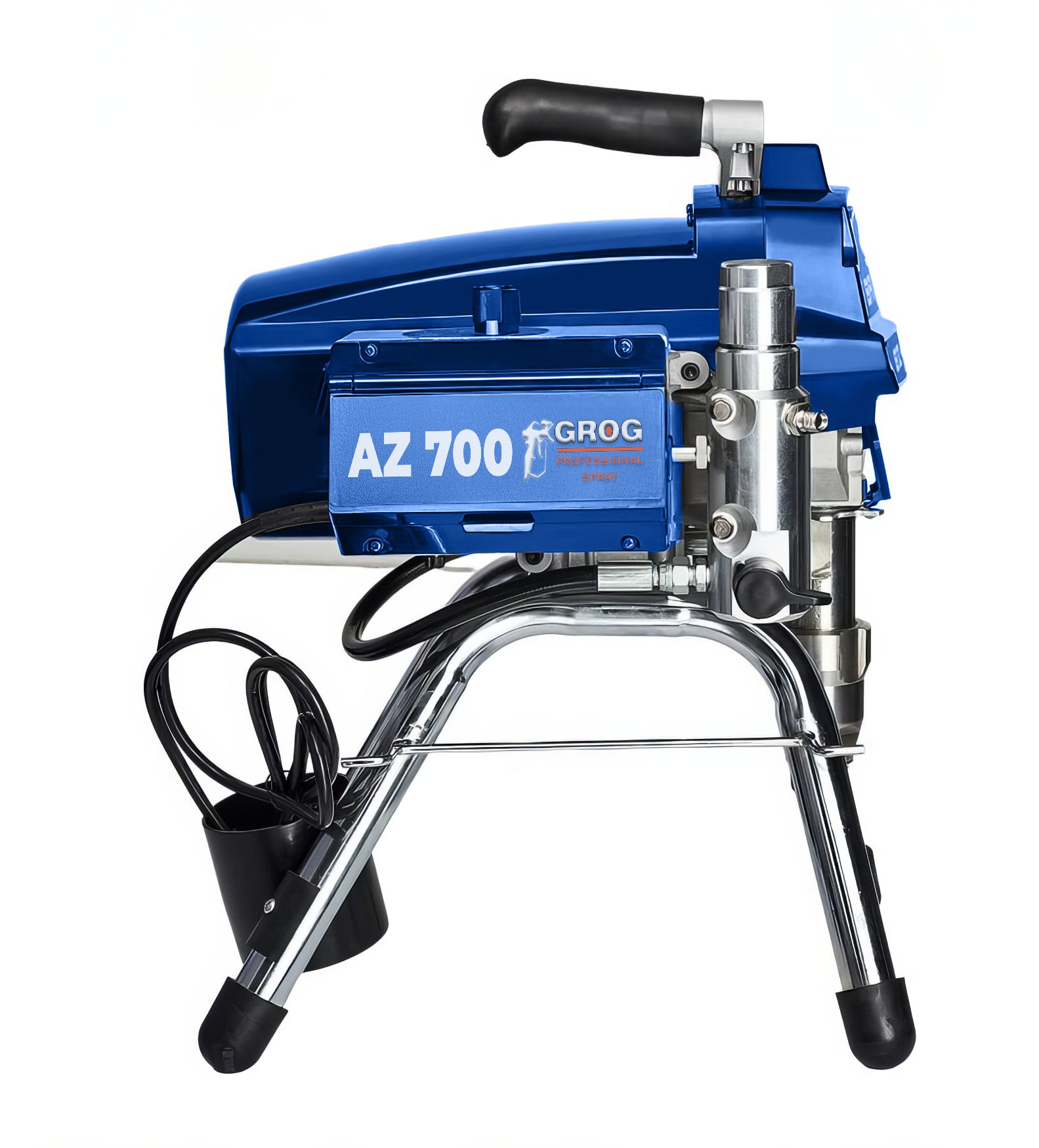
The GROG AZ600 (max 0.025″, 3 L/min) is the compact choice for lacquers, primers and interior wall paint — the tip range up to about 0.021″. The GROG AZ700 (max 0.031″, 4 L/min) also covers facade paint and large areas. For thick textured and protective coatings as well as filler and plaster with large tips, the GROG F4L (max 0.035″, 6 L/min) is built. If you are still unsure which unit to pick, the guide choosing an airless paint sprayer helps further; all units are in the electric airless category.
Frequently asked questions (FAQ)
What does 517 mean on an airless tip?
The first digit (5) is the fan width: multiplied by two it gives about 10 inches / 25 cm fan width at roughly 30 cm distance. The last two digits (17) are the orifice of 0.017″. A 517 suits primer and wall paint well.
Which tip for wall paint (emulsion)?
For interior emulsion, an orifice of 0.017–0.021″ is common — tips like 517, 519 or 521, depending on viscosity and desired fan width. 0.017–0.019″ is the all-rounder for walls and ceilings.
Which tip for lacquer?
Lacquers, water-based lacquers and enamel are thinner and need small orifices of about 0.011–0.015″ (e.g. 411 or 413) for a fine finish — usually at lower pressure.
Which tip for primer?
Primers are mostly in the 0.015–0.019″ range. The exact orifice depends on the specific primer's viscosity — the data sheet states the recommended range.
Which tip for facade paint?
Facade paints are thicker and are usually applied with 0.021–0.027″ and a wide fan (first digit 5 or 6) to coat large areas quickly and evenly.
How do I recognise a worn tip?
By a widening, irregular pattern, streaks or tails at the edges, and rising material consumption. A worn tip should be replaced, as it degrades quality and economy.
Conclusion
The right airless tip is the sum of three decisions: the orifice matched to the material's viscosity, the fan width matched to the component, and the pressure matched to both. Understanding the numbering system and following the material's data sheet avoids the most common mistakes and gives an even, economical result. Make sure the tip fits your unit's maximum tip size: the GROG AZ600 covers lacquers and wall paint, the GROG AZ700 also facade paint, and the GROG F4L thick coatings with large tips. Find all models in the electric airless category.