Painting facades with airless: faster and more even
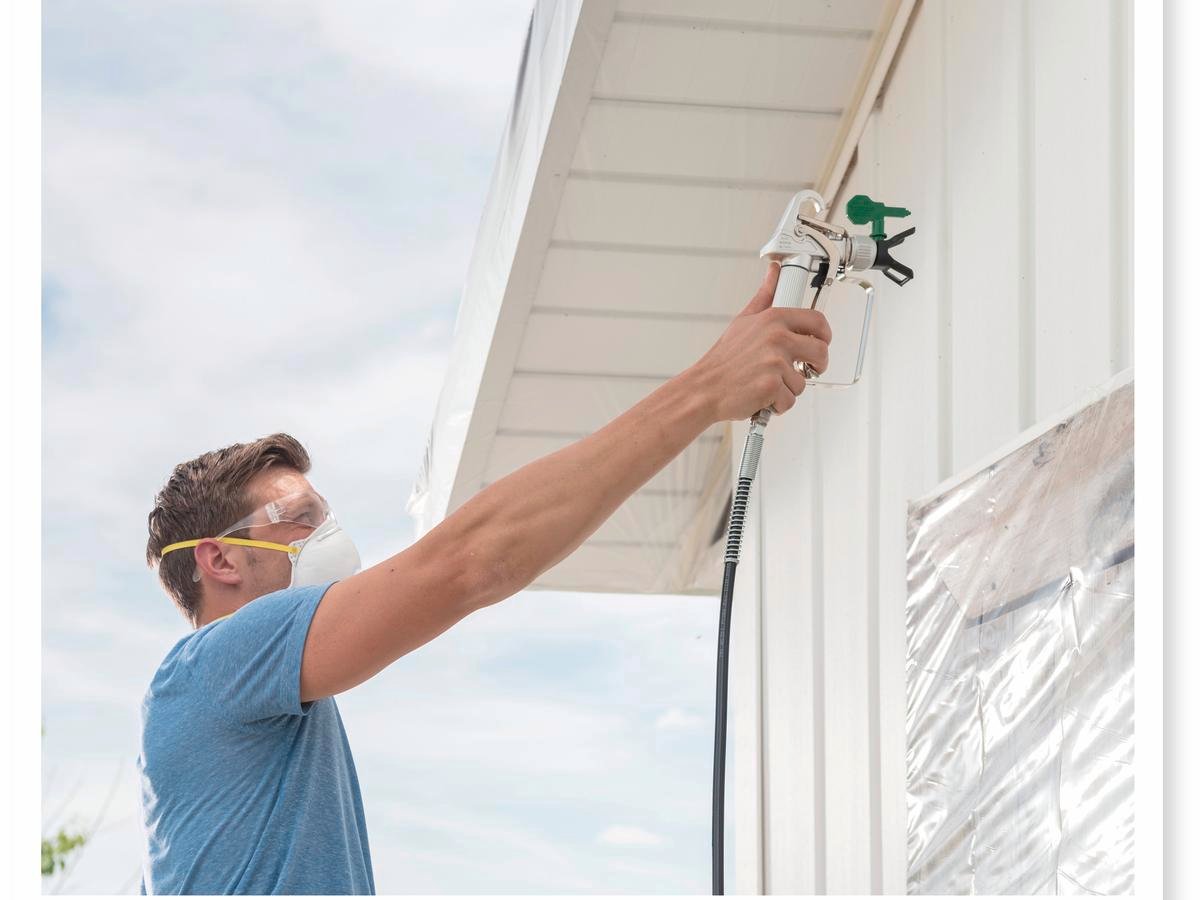
Painting a whole facade with roller and brush takes days and costs energy. With an airless sprayer you apply facade paint over large areas, evenly and in a fraction of the time — a decisive advantage for painting, facade and renovation firms that must work economically. This post shows what really matters when painting facades with airless: preparation, tip choice, technique, common mistakes and the right unit.
Why paint facades with airless?
In the airless method, paint is atomised at the tip by high material pressure alone, without compressed air. On a facade this brings several advantages:
- Speed: large continuous areas are coated much faster than with a roller.
- Evenness: a constant, closed paint film without roller texture.
- Reach: textured substrates, grooves and profiles are covered better than with a roller.
- Economy: less labour time per square metre, especially on large objects.
Modern electric airless units are compact and ready to use without a separate compressor — ideal for mobile facade work.
There is also better reach into textured substrates: where a roller on rough render or profiled surfaces mainly hits the raised areas, the spray reaches recesses and grooves too. The result is a closed, even coating that convinces both visually and in durability — an important point on demanding facades.
Which equipment do you need for facades?
Besides the sprayer itself, the equipment decides pace and result on a facade:
- A safe scaffold or certified work platform for even access to the whole surface.
- A high-pressure hose long enough to keep the unit on the ground and let you work flexibly.
- A gun extension for high walls, eaves and hard-to-reach areas.
- Tips matched to the facade paint — keep several sizes on hand if unsure.
- Plenty of covering material, masking tape and — in wind — protective netting against overspray.
- Personal protective equipment: safety glasses, gloves and respiratory protection.
Reach is decisive on a facade: a long hose and an extension save constantly moving the unit and let you finish an area quickly in one go — the prerequisite for a join-free result.
Which facade paints can be sprayed?
Most common facade coatings are sprayable — given the right tip and a unit matched to the viscosity.
| Coating | Sprayability | Note |
|---|---|---|
| Emulsion facade paint | very good | standard case, medium tip |
| Silicone resin paint | good | mind viscosity and tip recommendation |
| Silicate paint | good, material-dependent | follow manufacturer data |
| Primer / deep primer | very good | before the topcoat, thin |
| Thick mineral plaster | only with a strong unit | large tip, high flow (F4L) |
Important: the paint data sheet gives the recommended tip range and often the required thinning. Stick to it — it saves rework.
Preparation: substrate, masking, weather
When spraying facades, preparation decides the result. Overspray and poor adhesion are almost always preparation errors.
Check the substrate above all for soundness and absorbency. If the old coating chalks, flakes or is under tension, it must be removed — otherwise the new coat comes off with it. Highly absorbent substrates such as mineral plasters are primed so the paint does not set too fast and covers evenly. A simple wipe test (does the surface chalk?) and a wetting test (does sprayed water soak in immediately?) quickly reveal the facade's condition.
Checklist before spraying
- Check the substrate: clean, sound, dry; remove loose old coatings.
- Repair cracks and damage, prime where needed.
- Carefully mask and cover windows, doors, plinth, ground and adjacent areas.
- Mind the weather: no direct sun on the surface, no wind (overspray), no rain.
- Mix and, if needed, thin the material per the data sheet.
- Prepare the unit, hose and tip and dial it in on a test area.
Wind is especially critical on facades: it carries spray mist onto cars, neighbouring buildings and plants. When in doubt, postpone the day or use wind protection.
The right tip and spray technique for facades
The tip determines fan width and material output. The tip number combines both: the first digit (doubled) gives the fan width, the last two the orifice in thousandths of an inch. For facade paint, medium orifices are common depending on the material, with a wide fan angle on large areas.
| Material | Typical orifice | Note |
|---|---|---|
| Primer / thin | approx. 0.017–0.021″ | fine application |
| Emulsion facade paint | approx. 0.021–0.027″ | standard on facades |
| Thicker facade paint | approx. 0.027–0.031″ | higher material output |
| Textured/thick coating | 0.031″ and larger | strong unit required |
Technique tip: even pace, constant distance (about a hand's width plus), overlap passes by around 50 %, and guide the gun parallel to the wall — do not swing from the wrist. This creates a closed, even film.
Painting the facade step by step
A facade is rarely finished in a single step. A typical, plannable sequence looks like this:
- Create access: erect a scaffold or provide certified access equipment so all surfaces are safely and evenly reachable.
- Prepare the substrate: clean, remove loose old coatings, repair cracks and damage.
- Apply primer: prime absorbent or critical substrates per the system specification.
- Mask and cover: protect windows, doors, plinth, ground and adjacent areas; add netting in wind.
- Spray the first coat: in continuous passes, wet-on-wet, without interruption per surface.
- Spray the second coat: after the drying time stated by the manufacturer.
- Rework edges, junctions and details, then clean the unit thoroughly.
Plan the order of surfaces so you always finish a complete, continuous wall in one go. Interruptions mid-surface lead to visible joins that can hardly be hidden later.
Multi-coat build-up and material consumption
Facade coatings are usually built up in several coats: a primer plus two topcoats is the standard for an opaque, durable result. The exact consumption per square metre is in the paint's data sheet and depends strongly on substrate and texture. Textured or highly absorbent facades use more material than smooth, closed surfaces.
Always budget a small reserve. A continuous second coat over the whole area is cleaner than touching up individual spots afterwards, which otherwise stay visible in raking light. Spraying distributes material more evenly than rolling — which benefits both appearance and durability.
Spraying vs. rolling on facades
| Criterion | Airless spraying | Rolling |
|---|---|---|
| Speed | very fast on large areas | slow, high time cost |
| Surface | even, texture-safe | roller texture, less even |
| Preparation | masking/covering required | little masking |
| Spray mist | overspray possible (wind!) | no spray mist |
| Economy on large areas | high | low |
Common mistakes when spraying facades
- Sprayed in wind or direct sun — overspray and too-fast drying.
- Substrate not cleaned or not primed — paint adheres poorly.
- Too-small tip for thick facade paint — pressure drop, poor pattern.
- Uneven pace or wrong distance — streaks and clouding.
- Passes overlapped too little — visible joins.
- Poor masking — laborious rework on windows and plinth.
Safety and overspray on facades
On a facade, two risks combine: working at height and the very high pressure of the airless jet. So mind the following:
- Use a safe scaffold or certified access equipment — never spray from unsecured ladders.
- Never point the jet at people; engage the trigger lock during breaks and release the pressure before any maintenance — the jet can cause injection injuries.
- Wear safety glasses, gloves and respiratory protection.
- Limit overspray: do not spray in wind, use netting and generous covering, and keep pressure only as high as necessary.
- Protect or remove cars, plants and neighbouring buildings within the spray area.
A well-adjusted unit with the right tip and a sensible pressure produces far less spray mist than an over-cranked one — saving material and reducing rework. After use, the rule is the same as for any airless unit: clean pump, hose, gun and tip immediately until the flush water runs clear, and check the filters so no paint residue dries in.
Cost and economics
Getting into spraying costs more at first than roller and brush — unit, tips, hoses and masking all add up. On large facades that amortises quickly, however: the saved labour time per square metre is the decisive lever, and an even machine application further reduces rework. For firms that coat facades regularly, owning a unit usually pays off after a few jobs; for a one-off project, renting may make sense.
Recommended GROG units for facades
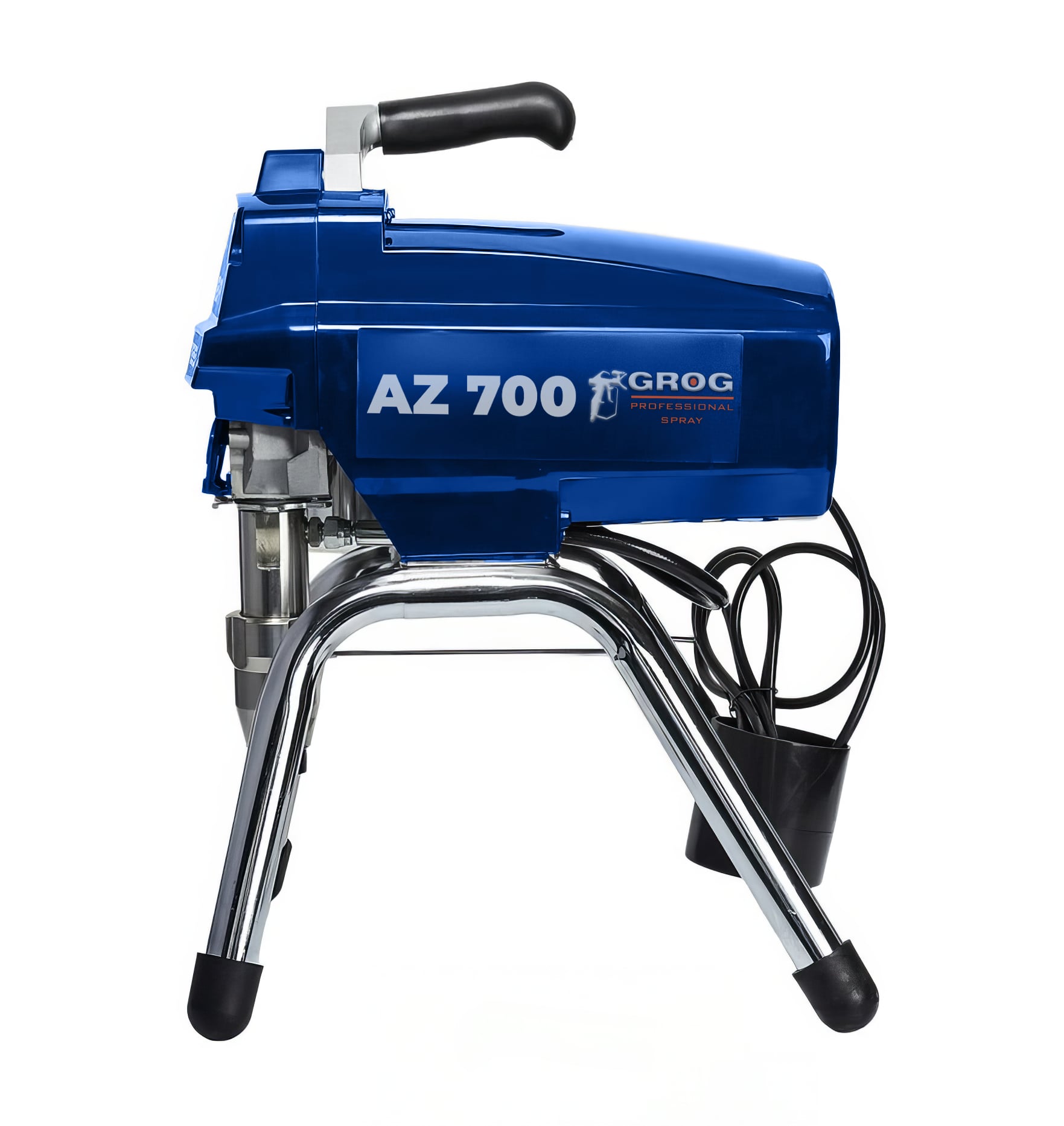
For large-area facade work the GROG AZ700 is the right unit: with 4 L/min at 227 bar and a strong 4200 W motor it feeds thicker facade paints and tips up to 0.031″ — enough reserve for fast work on large walls.
| Model | Pressure | Flow rate | Max tip | Motor | Recommended for |
|---|---|---|---|---|---|
| GROG AZ700 | 227 bar | 4 L/min | 0.031″ | 4200 W | large facades, thicker facade paint |
| GROG AZ600 | 227 bar | 3 L/min | 0.025″ | 3500 W | smaller facades, primer, wall paint |
| GROG F4L | 227 bar | 6 L/min | 0.035″ | 3800 W | thick mineral plasters, filler |
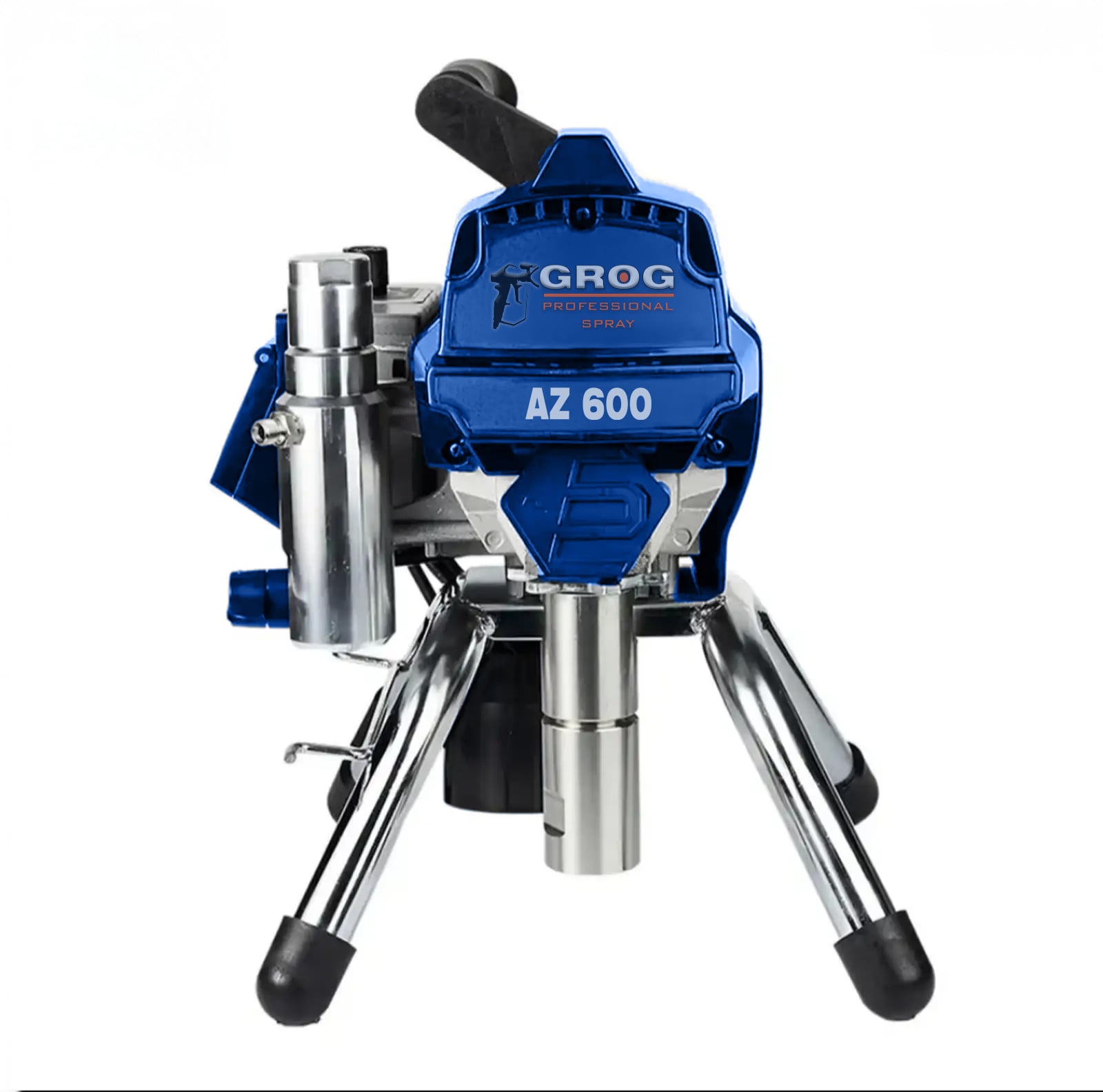
The more compact GROG AZ600 (3 L/min, 25 kg) is the economical choice for smaller facades, primers and wall paint. If, by contrast, thick mineral plasters or filler come into play on the facade, the GROG F4L with 6 L/min and tips up to 0.035″ is the right unit — it is built for high-viscosity materials.
Frequently asked questions (FAQ)
Can you paint a facade with airless?
Yes, and for large areas it is the most economical method. The right tip, a unit matched to the paint and good preparation (masking, substrate, weather) are key.
Which airless unit for facades?
For large facades with emulsion or silicone resin paint, the AZ700 (4 L/min, 0.031″) is ideal. The AZ600 covers smaller facades and primers. For thick mineral coatings, reach for the F4L.
Which tip for facade paint?
For normal emulsion facade paint, orifices around 0.021 to 0.027″ are common, up to 0.031″ for thicker paints. The exact value is in the paint's data sheet.
What about the weather?
Do not spray in strong sun, wind or rain. Sun dries the paint too fast, wind spreads overspray, rain ruins the fresh coat.
How many coats does a facade need?
Usually a primer plus two topcoats. On critical substrates or strong colour changes an extra coat may be needed. The paint's system data sheet is decisive.
What flow rate does a facade unit need?
For common emulsion and silicone resin facade paints, around 3 to 4 L/min is a good guide — the GROG AZ700 delivers 4 L/min and thus enough reserve for large areas. For thick mineral coatings a stronger unit like the F4L with 6 L/min makes sense.
How do you clean the unit after facade work?
Right after painting: pump residual material back and flush the system with water until it runs clear. Clean the tip, filters and gun separately. Drying paint residue is the most common cause of a poor spray pattern on the next job.
Conclusion
Painting facades with airless is faster, more even and more economical on large areas than a roller — provided preparation, tip choice and unit are right. For most facade work the GROG AZ700 is the unit to pick, the GROG AZ600 the compact alternative for smaller areas, and the GROG F4L the solution for thick mineral plasters. Find all models in the electric airless category.