Spraying Ceilings and Interior Walls with an Airless Sprayer
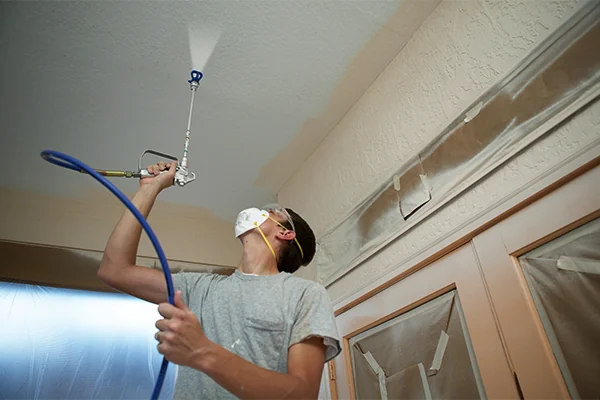
Ask any decorator which part of a repaint they would gladly hand off, and the ceiling comes up first. Rolling overhead is slow, drips, and leaves texture. An airless machine turns a ceiling into a few steady passes and gives a flat, roller-free finish — and the same setup then does the walls. The trade-off is overspray, so the whole method rests on two things: thorough masking and even gun control. Here is how professionals spray interior ceilings and walls.
Why spray interior surfaces?
Speed is the obvious gain — a machine lays paint far faster than a roller over a large area — but the finish matters just as much. A sprayed coat has no roller stipple, which is exactly what glancing light across a ceiling tends to show. For new plaster, fresh filler or a colour change across a whole room, spraying is the quick route to an even, uniform surface. A compact electric airless machine is enough for most interior rooms.
Mask first — this is most of the job
Indoors, there is nowhere for overspray to go, so masking is not a formality. Before any paint:
- Cover the floor completely and without gaps, right into the corners.
- Mask windows, doors, frames and any trim that keeps its original colour.
- Remove socket and switch plates and tape over the boxes.
- Protect anything left in the room, and close the door to the rest of the home.
Time spent here is saved many times over in clean-up. Our guide to reducing overspray goes into fans, filters and technique that keep stray mist down.
Set up the machine and paint
Use a tip sized for wall paint — a mid-range finishing tip rather than a heavy filler tip — and start the pressure only as high as it needs to be for a clean, tail-free fan. Our guide to which tip for which paint helps you match it. Emulsion often sprays better slightly thinned; follow the paint's data sheet for how much water it allows, and test the pattern on a masked area before you commit to the ceiling.
Distance, angle and speed
The fundamentals are the same as all airless work and are worth getting right:
- Keep the gun perpendicular to the surface and a hand's breadth or so away, the same distance throughout the stroke — don't arc your wrist, which thins the ends of each pass.
- Move at a steady speed. Too slow floods and runs; too fast leaves a thin, streaky coat.
- Trigger on and off past the edges so you don't build up at the start and end of a stroke.
For the full breakdown, see correct airless spraying technique.
Overlap and sequence
Even coverage comes from consistent overlap: lap each pass generously over the last — around half the fan is a safe habit — so there are no light bands between strokes. Then work in a logical order:
- Ceiling before walls, so wall passes cover any ceiling edge mist.
- Cut in the ceiling-to-wall corners first, then spray the ceiling in one direction and, if needed, a second coat across it the other way so the light does not catch a direction.
- On walls, work top to bottom and keep a wet edge, finishing one wall before moving on.
Second coat and back-rolling
Two thinner coats beat one heavy coat for evenness and coverage. If the specification wants a slight texture, or to key the surface, some painters back-roll the sprayed coat while wet — spraying lays the paint, the roller evens the film. We cover when that helps in back-rolling after airless spraying.
Common mistakes
- Thin masking — indoor overspray reaches everywhere; protect the whole room.
- Arcing the gun — thins the ends of each pass and leaves wavy coverage.
- Pressure too high — more overspray and faster tip wear for no better finish.
- Spraying walls before the ceiling — ceiling mist lands on finished walls.
- One heavy coat — runs on walls and poor hiding; two thin coats are better.
FAQ
Do I still need to prime?
Yes, on new plaster, fresh filler or bare board. Prime for even absorption, then spray the topcoat — see our primer spraying guide.
How much overspray should I expect indoors?
Less than older systems, but real. Fine mist settles around the room, which is why full masking and sensible pressure matter. The overspray guide has the detail.
Is spraying worth it for one small room?
For a single small room the masking time can outweigh the spraying time. Spraying pays off on larger areas, whole rooms, ceilings and colour changes.
Conclusion
A machine takes the worst job in decorating — the ceiling — and makes it quick and flat, then carries straight on to the walls. The result comes down to discipline: mask the room properly, keep the gun square and moving at a steady distance, overlap every pass, and work ceiling-first in two thin coats. Get those right and you trade a day of rolling for a few clean passes. See the electric airless range to pick a machine sized to your rooms.