Why Use a Whip Hose on an Airless Sprayer
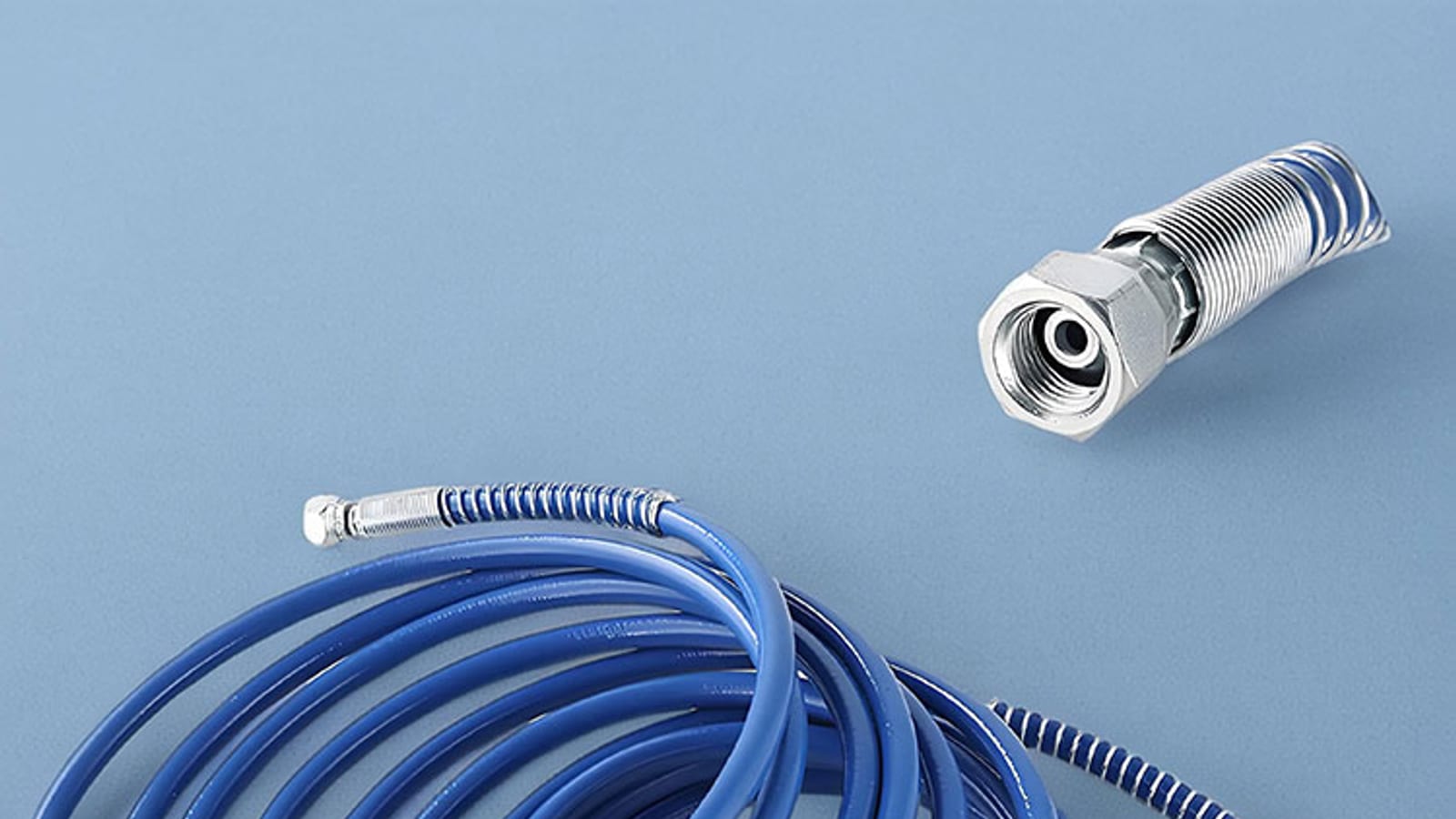
Anyone who has sprayed for more than an hour with nothing but the stock hose running straight to the gun knows the problem: the hose fights you. It kinks, it drags, it refuses to lie flat around corners. A whip hose — a short, smaller-diameter length of hose spliced between the main line and the spray gun — exists specifically to fix that.
What a Whip Hose Actually Does
A whip hose is a short length of airless hose attached to the end of the main spray hose, connecting it to the spray gun. It doesn't replace your main line; it supplements it, acting as a flexible joint right where you need agility most — at the gun.
The reason this matters comes down to physics. A 1/4 inch ID main hose is the most common size for residential and light-commercial work, and it's a good compromise between flow and weight — but once it's pressurized and loaded with paint, it becomes very stiff and difficult to move around. Every turn of the wrist has to fight that stiffness. Over a full day, that resistance adds up.
Smaller Diameter, More Flexibility
The core trick behind a whip hose is diameter. Drop from a 1/4 inch main line to a 3/16 inch whip and the hose becomes noticeably easier to coil, bend, and snap around obstacles. For jobs where you need the absolute maximum flex, 1/8 inch ID whip hoses exist and are considered the most flexible option among high-pressure airless hoses available. The smaller bore, paired with different wall construction, is what creates that added suppleness — not a drop in pressure rating.
Less Fatigue, More Control
Manufacturers are consistent on this point. Graco notes that its whip hoses provide flexibility and control at the gun, and are particularly useful when spraying for long periods, where they help reduce fatigue. That tracks with real-world feedback: painters report that the smaller diameter and different materials of a whip greatly improve flexibility, which helps in tight spots and noticeably reduces fatigue over a shift.
Distributors frame this in business terms, too — on large jobs, a whip hose helps maintain a consistent finish over the course of an entire day, because an operator who isn't wrestling with a stiff hose makes smoother, more even passes.
Getting Into Tight Spots
Beyond comfort, a whip hose changes what's physically reachable. The flexible break it introduces makes it easier to move the gun around corners, eaves, and under decks — situations where a rigid main hose would force you into an awkward angle or an incomplete pass. This is one reason whip hoses show up so often in trim, cabinet, and fine-finish work, where gun control near the surface matters more than raw flow.
Cloth Braid vs. Wire Braid
Whip hoses aren't all built the same way. Wire-braided versions are more durable overall but can kink, which creates a weak point that wears faster at that exact spot. Cloth-braided versions are softer and more forgiving in the hand, but they can't be grounded, which matters for static-sensitive coatings. Some premium designs skip rigid reinforcement at the hose ends entirely, specifically to cut down on wrist strain during long sessions. Which construction suits you depends on how much grounding matters for your material versus how much flex you want at the gun.
Pressure Ratings Still Matter
A smaller diameter doesn't mean a lower pressure rating — whip hoses still need to handle full airless system pressure. GROG's own airless hoses are rated to 227 bar, with GROG guns rated to 270 bar, and any whip hose you add to a GROG system should meet or exceed the hose rating to stay within that envelope. Our HP airless hose is built to that same pressure standard.
Matching the Whip to Your Coating
Diameter choice isn't just about comfort — it affects what you can spray through it. The narrowest 1/8 inch whips are best suited to low-viscosity coatings such as stains, lacquers, and oil-based paints, where thin material moves easily through the reduced bore. Thicker coatings — primers, latex, heavier finishes — generally call for the more common 3/16 inch whip instead, since forcing high-viscosity paint through too narrow a hose fights the pump and can affect atomization at the tip. If you're dialing in viscosity and tip selection together, our tip and filter matching guide walks through how hose bore, filter mesh, and tip orifice all interact.
Protecting the Rest of Your Setup
A whip hose also takes on wear that would otherwise concentrate at the gun connection and the end of the main hose. By absorbing the twisting and bending motion close to the gun, it spares that junction the repeated flexing that leads to premature cracking or leaks. Keeping the rest of the system clean matters just as much — a properly maintained gun filter, pump filter, and suction filter all reduce the load on the whip and tip alike; our filters explained guide covers how the three stages work together.
Combined with a well-chosen tip — whether that's a fine finish tip for cabinetry or a heavy duty tip for coatings — a whip hose rounds out a setup built for control, not just output.