Airless Sprayer Filters Explained: Suction, Pump and Gun Filters
Clogged tips, spitting patterns, and premature pump wear usually trace back to one thing: filtration. Airless sprayers push material at high pressure through progressively smaller openings, and each stage of that journey needs its own filter to catch a different size of contaminant. Understanding what each filter does — and matching mesh size correctly — is one of the simplest ways to protect your equipment and get a clean finish.
The Three-Stage Filtration System
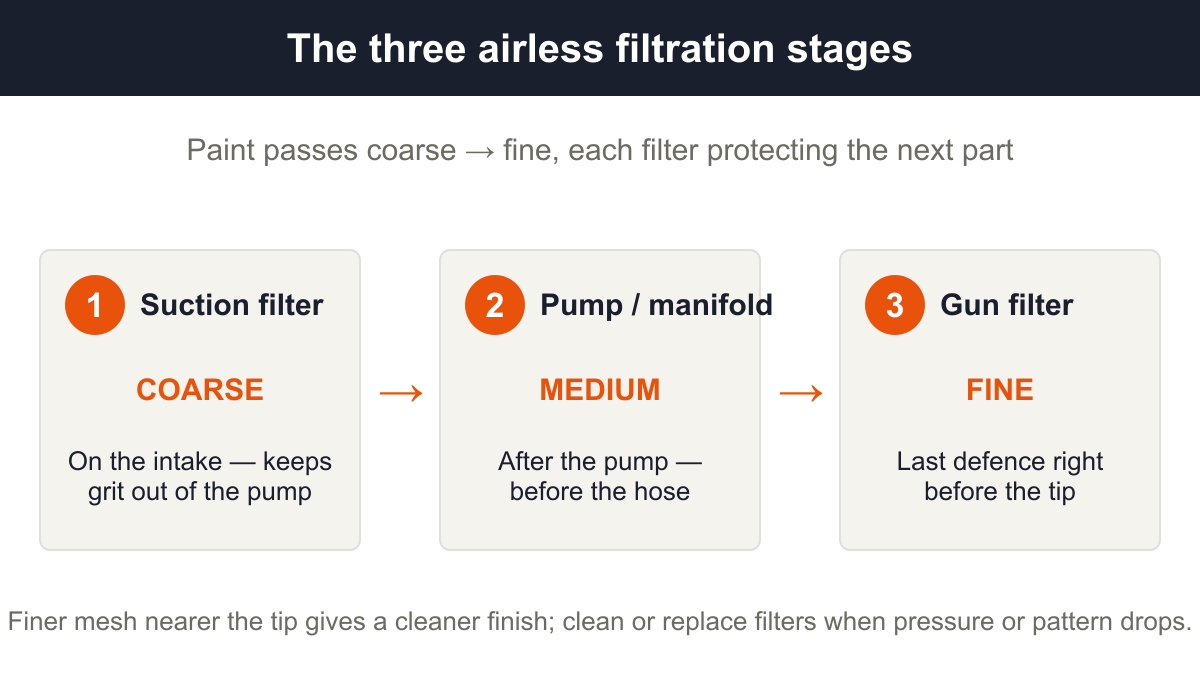
Airless sprayers typically filter material three times before it ever leaves the tip.
1. Suction / Inlet Strainer
This is the first line of defense, mounted on the suction tube where material enters the pump. It's a coarse, heavy-duty strainer whose job is to filter debris and solids before they enter the pump, protecting packings, valves, and other internal components from damage. In the field, these are often nicknamed "rock catchers" because they're built to stop chunks, skins, and grit that would otherwise chew up pump internals.
GROG's suction filter is a coarse intake strainer with a 1-inch connection, designed to sit ahead of the pump as this first stage.
2. Pump / Manifold Filter
Inside the pump body, a second filter offers finer filtration before material is forced into the high-pressure hose. This stage catches medium-sized particles the inlet strainer let through, reducing the load on the final gun filter and helping maintain consistent pressure through the hose.
GROG's pump/manifold filter sits after the pump and provides this fine second-stage filtration.
3. Gun Filter
The last filter sits inside the spray gun handle, right before material reaches the tip. It needs to be the finest of the three, because it's guarding the smallest and most easily blocked orifice in the whole system. Industry guidance consistently frames gun and pump filters as being as important as spray tip selection — even pre-strained material can carry dust, paint skin, or manufacturing particles that clog a tip mid-job.
GROG's gun filter is a push-in gun-handle design available in 60 mesh (0.31 mm openings) and 100 mesh (0.15 mm openings), covering the two most common finishing needs.
Why the Order Matters
Progressive filtration means each stage protects the next from a different scale of contaminant. Skip the inlet strainer and you risk grit tearing up pump seals. Skip the pump filter and larger particles reach the pressurized hose. Skip or under-spec the gun filter and even fine debris will lodge in the tip orifice, causing tailing, spitting, or a blocked tip mid-coat. Running all three, correctly sized, is what keeps pressure stable and the spray fan clean from the first stroke to the last.
Matching Mesh Size to Material
The core rule across the industry: thinner, lower-viscosity materials need finer mesh; thicker, heavier-bodied materials need coarser mesh. Mesh sizes are commonly color-coded so you can identify them at a glance.
Mesh · Typical Color · Best For
30 mesh · Green · Heavy-bodied or gritty coatings, larger tip sizes
50 mesh · White · Most latex paints
60 mesh · White/Black · Latex and enamels, commonly with .015″–.029″ tips
100 mesh · Yellow/Orange · Oil-based paints, stains, lacquers, enamels
180–200 mesh · Red · Very low-viscosity oils, mold release agents, thin enamels
As a general practice, the pump filter and gun filter are matched to the same mesh rating for a given job, so neither stage becomes an unnecessary bottleneck. For a deeper breakdown of how tip size, mesh, and coating type interact, see the Airless Spray Tip & Filter Guide.
Mesh Number vs. Micron Size
Mesh count alone doesn't tell the whole story. The actual opening size — often expressed in microns or millimeters — depends on wire thickness and weave, so two filters with the same mesh rating can behave slightly differently. When in doubt, check the manufacturer's stated opening size rather than relying on mesh number alone, especially for fine-finish work where clogging tolerance is tight.
Maintenance and Failure Signs
Filters should be checked regularly, not just when a problem appears. Warning signs include a spray pattern that tails off at the edges, sudden pressure surges, or a tip that clogs repeatedly despite being clean. Torn mesh, compressed strainers, or filters clogged with dried material should be replaced immediately rather than rinsed and reused indefinitely — a damaged filter can pass exactly the debris it's meant to stop. If you're troubleshooting inconsistent spray quality, it's also worth checking tip condition alongside filtration; see When to Replace an Airless Spray Tip for the signs of tip wear versus a filtration problem.
Building a Complete, Clean Spray Path
Filters work as a system alongside the rest of your setup. GROG's lineup covers all three stages — suction filter, pump filter, and gun filter — paired with five reversible tip families including the Standard, Fine Finish, High Efficiency, Low Pressure, and Heavy Duty tips. A tip guard adds a layer of safety at the nozzle, while GROG's hoses are rated to 227 bar and guns to 270 bar, giving the pressure headroom that clean, correctly filtered material needs to atomize properly at the tip. Pairing the right mesh with the right tip — and keeping both clean — is what separates a smooth finish from a frustrating callback.