Correct Airless Spraying Technique: Distance, Angle, Speed and Overlap
A perfectly set-up airless sprayer will still produce a poor finish in untrained hands. Once the pressure and tip are right, the quality of the coat comes down to how you move the gun: the distance you hold it from the surface, the angle you keep it at, how fast and steadily you move, and how you overlap each pass. These four fundamentals are what separate a flat, even film from one marked by stripes, runs and thin spots.
This guide covers the core gun-handling technique that applies to almost any airless job, from walls and ceilings to doors, cabinets and facades. The habits are simple, but they only become automatic with deliberate practice — ideally on scrap material before you commit to the real surface.
The four fundamentals
Every clean airless coat rests on four things done consistently: correct distance, a perpendicular angle, a steady stroke speed, and a disciplined overlap. Get all four right and the film is uniform. Let any one of them drift and the defect shows up immediately, because spraying builds the whole film in a single fast pass rather than working it in like a brush or roller.
Distance and angle
Hold a consistent distance
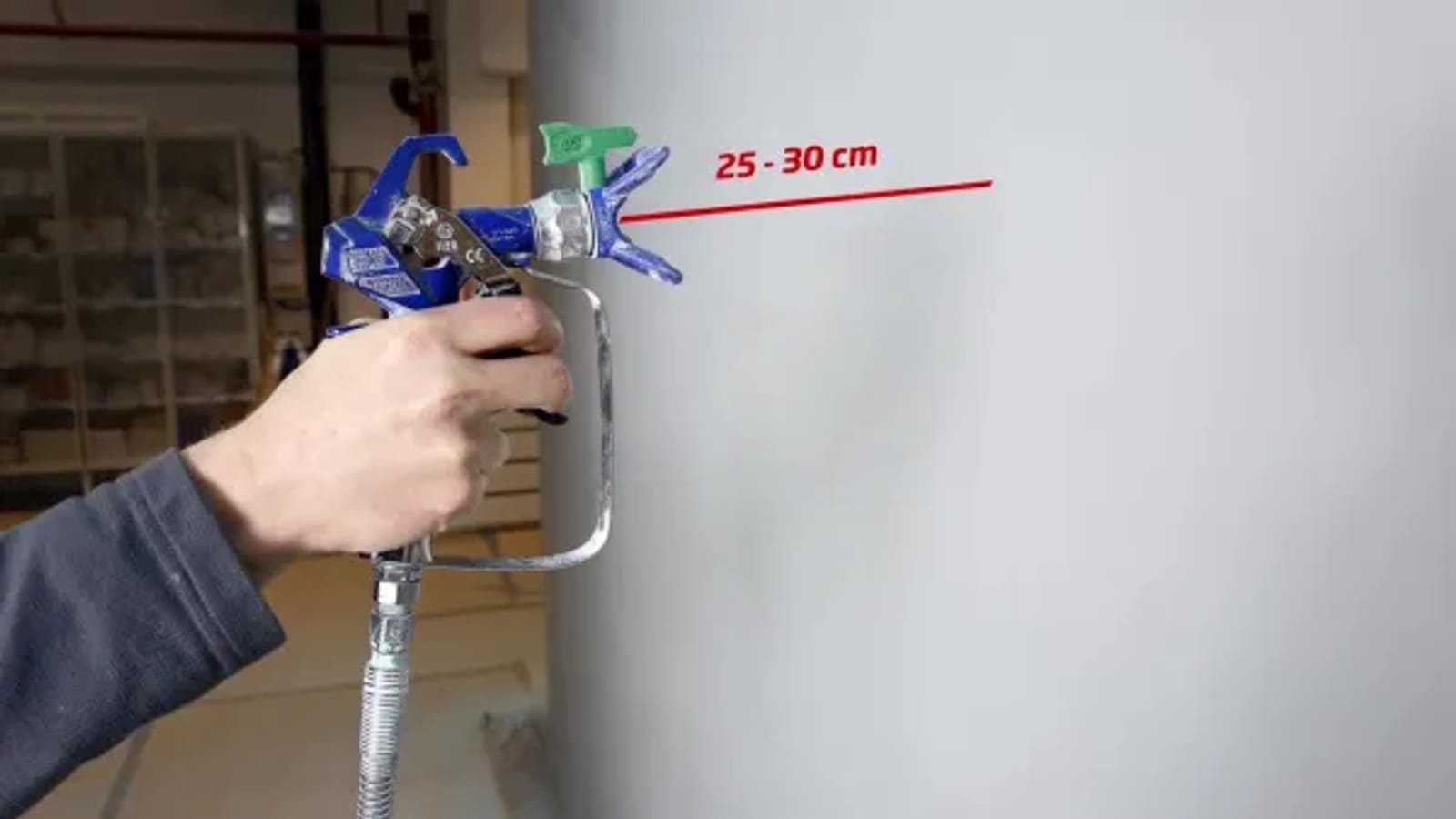
Hold the tip roughly 25–30 cm (about 10–12 inches) from the surface. That distance lets the fan open to its full width and deposit an even film. Too close and the fan is narrow and heavy, laying down a thick stripe that runs; too far and the droplets begin to lose energy and dry slightly in flight, giving a thin, rough, over-sprayed finish. The exact distance can vary with tip and material, but a steady, repeatable distance matters more than the precise figure.
Keep the gun perpendicular
Keep the gun square to the surface and move it parallel to that surface, so the tip stays the same distance away across the whole stroke. The most common fault is arcing — pivoting from the wrist or elbow so the gun swings through an arc. At the ends of an arc the tip is farther away and angled, so those areas receive less paint while the middle receives more. The fix is to move your whole arm, keeping the wrist locked, so the gun travels in a straight line at a constant distance.
Stroke speed
Move the gun at a steady, deliberate pace — fast enough to avoid loading too much material in one spot, slow enough to lay a full, wet coat. The single most important quality is consistency: a constant speed produces a constant film thickness. Slowing down mid-stroke dumps extra paint and invites runs; speeding up starves the surface and leaves it thin and patchy. Practise on scrap until a full, even wet layer at a steady speed feels natural.
Overlap each pass by 50%
A spray fan lays down more material in its centre than at its tapered edges, so passes must overlap to even out. The standard is a 50% overlap: aim the tip so each new pass is centred on the edge of the previous one. In practice, line the tip up with the bottom edge of the pass you just laid down and run the next stroke along it. That overlap fills the thin edges and produces one uniform film instead of visible bands of light and heavy coverage.
Triggering and edges
Feather the start and end of every stroke
Do not hold the trigger down continuously across a wall while starting and stopping over the surface — that piles paint where you begin and end. Instead, begin moving the gun first, then pull the trigger just as the tip reaches the work; release the trigger just before the end of the stroke while the gun is still moving, then stop. This triggering rhythm — move, trigger, release, stop — feathers the ends of each pass so they blend instead of building up.
Band the edges first
On a bordered area such as a wall or a panel, spray the outer edges first with a pass along each edge — a technique called banding — then fill the middle with your normal overlapping passes. Banding gives you a controlled, even border and stops the fan from spraying past the edge into overspray. For jobs where minimising waste is the priority, our guide on reducing overspray goes further, and correct pressure — covered in pressure and pattern adjustment — keeps the fan controllable in the first place.
Common technique mistakes
- Arcing the gun from the wrist, so the ends of each stroke are starved and the middle is heavy.
- Holding too close in an attempt to "cover faster", which creates thick stripes and runs.
- Inconsistent speed — slowing over problem areas and dumping paint, or rushing and leaving thin patches.
- Skipping the overlap or overlapping unevenly, which leaves visible bands once the coat dries.
- Triggering on and off while stopped over the surface, building heavy edges at the start and end of every pass.
Conclusion
Good airless technique is four disciplined habits repeated on every stroke: a consistent 25–30 cm distance, a gun held square and moved in a straight line, a steady stroke speed, and a 50% overlap — finished with feathered triggering and banded edges. None of it is difficult, but all of it needs to be deliberate until it becomes muscle memory, so practise on scrap before the real surface. Combined with correct pressure and tip setup, sound technique is what turns a capable machine into a professional finish. Explore GROG's airless sprayers to match a unit to the work you do.