How to Reduce Overspray When Using an Airless Paint Sprayer
Overspray is the paint that never reaches the surface - the fine mist that drifts, settles on everything nearby and disappears into the air as wasted material. Every airless sprayer produces some, but the gap between a controlled operator and a careless one is enormous. Excess overspray costs money in paint, adds hours of masking and cleanup, creates a health hazard and can damage cars, windows and finished work around the job.
The good news is that overspray is almost entirely controllable. It comes from a handful of variables, and once you understand how each one behaves you can dial it down to the minimum the coating and conditions allow. This guide works through those variables in the order that matters, from the settings on the machine to the way you move the gun.
Start with pressure - the single biggest lever
If you fix only one thing, fix pressure. The most common mistake by far is running the pump far higher than the paint needs. High pressure shears the coating into extremely fine particles, and the finer the particle, the less momentum it carries and the more it drifts instead of landing. Excess pressure is, quite literally, a mist generator.
The correct method is to set pressure as low as possible while still fully atomising the paint. Start low, spray a test pass, and raise pressure only until the tell-tale heavy edges - the tails or fingers at the ends of the fan - just disappear. The moment the pattern is uniform, stop. Every extra unit of pressure beyond that point buys you nothing but overspray and faster tip wear.
This is much easier on a machine with genuine, stable pressure control. A sprayer that holds a steady, adjustable pressure lets you find that sweet spot and keep it; a cheap unit that surges or offers only crude control forces you to run higher for safety, wasting paint on every job. Pressure control is not a luxury feature - it is the primary overspray control.
Choose the correct spray tip
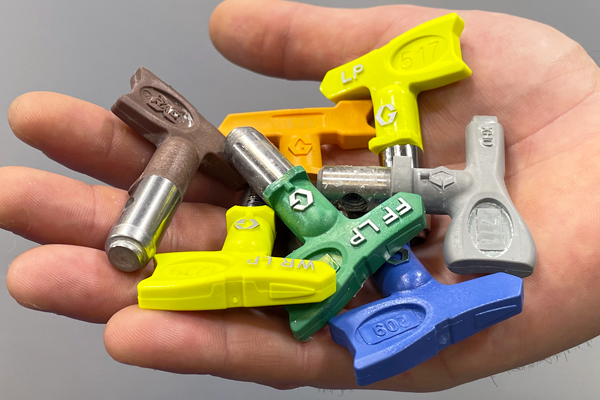
After pressure, the tip is the most important factor. An airless tip is defined by two numbers: its orifice size, which sets how much paint flows, and its fan width, which sets how wide the pattern sprays. Both influence overspray.
Orifice size
A larger orifice releases more paint and generally needs more pressure to atomise, so oversizing the tip increases overspray on two fronts. Use the smallest orifice that still delivers the coating properly. Thin materials such as stains and lacquers atomise with small tips at low pressure; thick materials such as masonry paint need a larger orifice, but only as large as the product actually requires.
Fan width
Match the fan width to the surface. A wide fan on a narrow surface throws most of the pattern past the edges as pure overspray. A fan roughly matched to the work - narrower for rails, posts and trim, wider for open walls - keeps paint on target. Worn tips also spray wider and rougher than their rating, so replace tips before they degrade; a worn tip quietly increases both overspray and paint use long before it fails completely.
Hold the correct spraying distance
Distance is a technique factor that operators get wrong constantly. The target for most coatings is about 25 to 30 centimetres from tip to surface - roughly the span of a hand. That distance places the surface where the fan is fully formed and the droplets still carry enough energy to land cleanly.
Too close and you deposit a heavy, narrow band that runs and sags. Too far and the droplets lose momentum, spread out and drift as overspray while the coat arrives thin and under-built. Just as important as the distance itself is keeping it constant. Many painters unconsciously arc the gun, swinging closer in the middle of a stroke and further at the ends. That arc thins the coat at the edges and multiplies overspray. Move the whole arm, keep the gun the same distance across the entire pass, and the pattern stays even.
Whatever the coating, spend the first minute on a test board or an offcut rather than the job itself. A short test pass shows at a glance whether pressure, tip and distance are producing a clean, even fan with no tails and minimal haze. It is far cheaper to correct the settings on scrap than to strip overspray off finished work, and it takes the guesswork out of the first stroke on the actual surface.
Keep the gun perpendicular - spray angle
The gun should point straight at the surface, with the tip perpendicular to it. When you tilt the gun and spray at an angle, one side of the fan is closer than the other: part of the pattern lands heavy while the far side thins out and drifts. Angled spraying is a hidden source of both uneven film and overspray.
The temptation to angle the gun usually appears at edges, ceilings and awkward corners, exactly where drift is most likely to land where it should not. Reposition your body so you can hold the gun square to the work rather than cocking your wrist. On inside corners, spray each face straight on rather than trying to hit both at once from an angle.
Control gun movement and overlap
A clean airless pass has a rhythm: start moving the gun before you pull the trigger, and release the trigger before you stop moving at the end of the stroke. Triggering while stationary dumps a heavy load in one spot and forces you to spray faster elsewhere to compensate. Moving first and stopping the spray last keeps the film even and avoids the heavy build that leads to runs and rework.
Overlap
Overlap each pass by about 50 percent - aim the centre of the new stroke at the edge of the previous one. Because a spray fan is heavier in the middle and lighter at the edges, a half-overlap layers the light edges together into a single, even film. Too little overlap leaves striping; too much builds an unnecessarily heavy coat and wastes paint. Consistent speed matters here as well: moving the gun at a steady pace keeps the film uniform, while speeding up and slowing down creates thick and thin bands that tempt you to over-apply.
Mask deliberately and contain the area
No matter how good the technique, some fine mist is inevitable, so containment protects everything you are not painting. Effective masking is not just about the surface next to your work - overspray travels, so think about the whole zone. Cover adjacent surfaces, floors and any nearby vehicles or glazing, and use plastic sheeting rather than thin paper where drift is likely.
For exterior work, screening or sheeting around the work area catches drift before it reaches a neighbour, a footpath or a parked car - the sources of most overspray complaints and claims. Investing a few extra minutes in containment is far cheaper than cleaning paint off a car or repainting a damaged surface later. Masking well also lets you spray with confidence and speed, because you are not constantly slowing down to protect the surroundings by hand.
Read the weather before you spray outdoors
Outdoor conditions can undo perfect technique. Wind is the worst offender: even a gentle breeze catches the fine fan and carries it metres from the target, thinning your coat and depositing overspray far and wide. As a rule, if you can feel a breeze on your face, it is affecting your spray pattern. Spray on calm days, work with any wind at your back rather than across the fan, and stop when gusts pick up.
Heat and humidity matter too. In hot, dry conditions the droplets begin to dry in flight, arriving as semi-dry particles that bounce off and float as dry overspray and dust. Very cold conditions thicken paint and can push you toward higher pressure. Mild, still, moderately humid weather gives the cleanest results with the least waste.
Why cutting overspray is worth the effort
It is tempting to treat overspray as an unavoidable side effect and move on, but the cost adds up quickly. On a job that uses a hundred litres of paint, the difference between disciplined technique and careless spraying can easily be twenty to thirty litres of material - paint that was bought, carried and pumped only to drift away, and then has to be cleaned off everything nearby. Multiply that across a season and it becomes a serious figure.
The hidden costs are larger still. Overspray landing where it should not means masking that should have been unnecessary, cleanup that eats into the next job, and the occasional expensive claim when mist reaches a vehicle or a neighbour's window. Reducing overspray is not fussiness - it is one of the most direct ways to protect both margin and reputation on spray work. Every technique in this guide pays back in less wasted paint, less cleanup and fewer complaints, which is why the best operators treat overspray control as a core skill rather than an afterthought.
Common overspray mistakes to avoid
- Running pressure higher than the coating needs - the number one cause of excess mist.
- Using an oversized or worn tip that releases too much paint and sprays too wide.
- Holding the gun too far from the surface, or letting the distance vary through the stroke.
- Arcing the wrist so the gun swings closer and further within a single pass.
- Spraying at an angle instead of keeping the tip perpendicular to the surface.
- Triggering the gun while stationary rather than moving before and after the spray.
- Skimping on masking and containment, then spending longer cleaning up than the job saved.
- Spraying outdoors in wind, or in heat that dries the droplets before they land.
None of these fixes require special equipment - they are habits. Combined with a machine that holds steady, adjustable pressure and a correctly sized, sharp tip, they turn overspray from a costly nuisance into a thin, controllable minimum. Less paint in the air means more paint on the surface, faster jobs, cleaner sites and fewer complaints.
Frequently asked questions
What is the biggest cause of overspray?
Excessive pressure. Running the pump higher than the material needs shears the paint into very fine particles that drift instead of landing. Lower the pressure to just above the point where tails disappear and most avoidable overspray goes with it.
Does a smaller spray tip reduce overspray?
Yes, within limits. A smaller orifice releases less material and allows lower pressure, both of which cut overspray. But the tip still has to match the coating - too small for a thick paint forces the pressure back up. Size the tip to the paint first, then enjoy the overspray benefit.
How far should I hold the spray gun from the surface?
About 25 to 30 centimetres - roughly a hand-span - for most coatings, kept constant across the whole stroke. Too close causes runs; too far lets droplets drift and the film go thin and dry.
Can weather affect overspray?
Strongly. Wind carries atomised paint far off target, and hot, dry air dries droplets in flight into dust. Spray in calm, moderate conditions and keep any breeze behind you rather than across the fan.
Is overspray dangerous?
Yes - treat it as both a health hazard and a liability. Never inhale atomised paint; wear proper respiratory protection. Drifting mist can also damage vehicles, glazing and finished work, so containment and calm conditions matter as much as technique.