Spraying Lacquer and Enamel for a Fine Finish
Lacquer and enamel reward precision more than any other coating. Both flow out thin, dry fast, and show every flaw of atomization — orange peel, tails, or a mottled sheen are impossible to hide on a glossy cabinet door or a painted railing. Getting a fine finish from an airless sprayer isn't about a special machine trick; it's about matching tip size, filter mesh, and pressure to a thin material, then holding the lowest pressure that still fully atomizes it.
How Airless Atomization Works
An airless sprayer uses a piston or diaphragm pump to push coating through a very small tip orifice at high pressure — typically in the 1,000–4,000 PSI range — with no compressed air involved. The pressure itself shears the material into fine droplets as it exits the tip. Graco describes this as moving coating through a small nozzle at high pressure to atomize it, and notes airless application can be up to ten times faster than brushing or rolling while still laying down an even film. That speed is an advantage on large areas, but on fine woodwork and metal trim, controlling *how* that atomization happens — droplet size, fan shape, pressure — matters more than raw throughput.
Decoding Tip Size Codes
Every airless tip carries a three- or four-digit code. The first digit, doubled, gives the fan width in inches; the last two digits give the orifice diameter in thousandths of an inch. A 517 tip, for example, sprays a roughly 10-inch fan (5 × 2) through a 0.017-inch orifice — the orifice is what controls how much material passes through and how coarse or fine the atomization will be. Smaller orifices atomize thinner materials more finely; larger orifices are built for volume, not finesse.
Choosing the Right Size for Lacquer and Enamel
Material · Typical orifice · Typical fan · Use case
Lacquers, stains, clear coats · 0.009"–0.013" · 4–6" · Cabinetry, trim, furniture
Waterborne lacquers · ~0.011" · varies by part · Cabinet doors (211), flat panels (411)
Oil-based enamels · 0.013"–0.015" · 8–10" · Doors, trim, metal railings
As a rule of thumb, small orifices (0.009"–0.013") suit thin, low-viscosity coatings like stains and lacquers, while medium sizes (0.015"–0.019") handle thicker acrylic latex and enamel. Finishers working water-based lacquer on cabinetry commonly settle on an .011" orifice — enough atomization for a fine, even coat — and simply change the fan width (a narrower pattern for door edges, a wider one for flat panels) rather than switching orifice size. GROG's reversible tip families cover this range; the Fine Finish Airless Tip and Low Pressure Airless Tip are the starting points for lacquer and enamel work, while the Standard Airless Tip and Heavy Duty Airless Tip cover thicker, higher-volume coatings.
Why Fine-Finish Tips Are Different
Standard tips are engineered for throughput, not surface quality. Purpose-built fine-finish tips change the internal geometry so a smaller orifice can still deliver full atomization at lower pressure — Graco's FFLP line claims up to 50% lower spray pressure with less overspray, while Titan's dual-orifice fine-finish tips pass the coating through two carbide inserts in sequence, with the first breaking up the stream and the second completing atomization. The reported benefit is up to 27% finer atomization than a standard tip of the same size, plus sharper paint edges and lower overspray — useful on cut-in work around hardware and glass. Running at lower pressure also extends tip life, since wear accelerates sharply with pressure and flow.
Filter Selection Matters as Much as Tip Size
Lacquer's thin viscosity means filter mesh choice is just as critical as orifice size. Industry mesh charts generally call for 100-mesh filters on solvent-based lacquers and enamels, 200-mesh for stains and varnish, and coarser 60- or 30-mesh only for latex and heavy fillers — too fine a mesh starves flow, too coarse lets contaminants through to spit at the tip. Some manufacturers specify an even finer 180-mesh filter for their smallest fine-finish orifices. GROG's three-stage filtration follows this same logic: a coarse suction filter with a 1-inch connection strains debris before the pump, a pump/manifold filter provides finer filtration immediately after, and a push-in gun filter — available in 60 mesh (0.31 mm) and 100 mesh (0.15 mm) — gives a final, material-matched pass right before the tip. For a deeper walkthrough of how the three stages work together, see the sprayer filters guide and the tip-and-filter matching guide.
Pressure Strategy
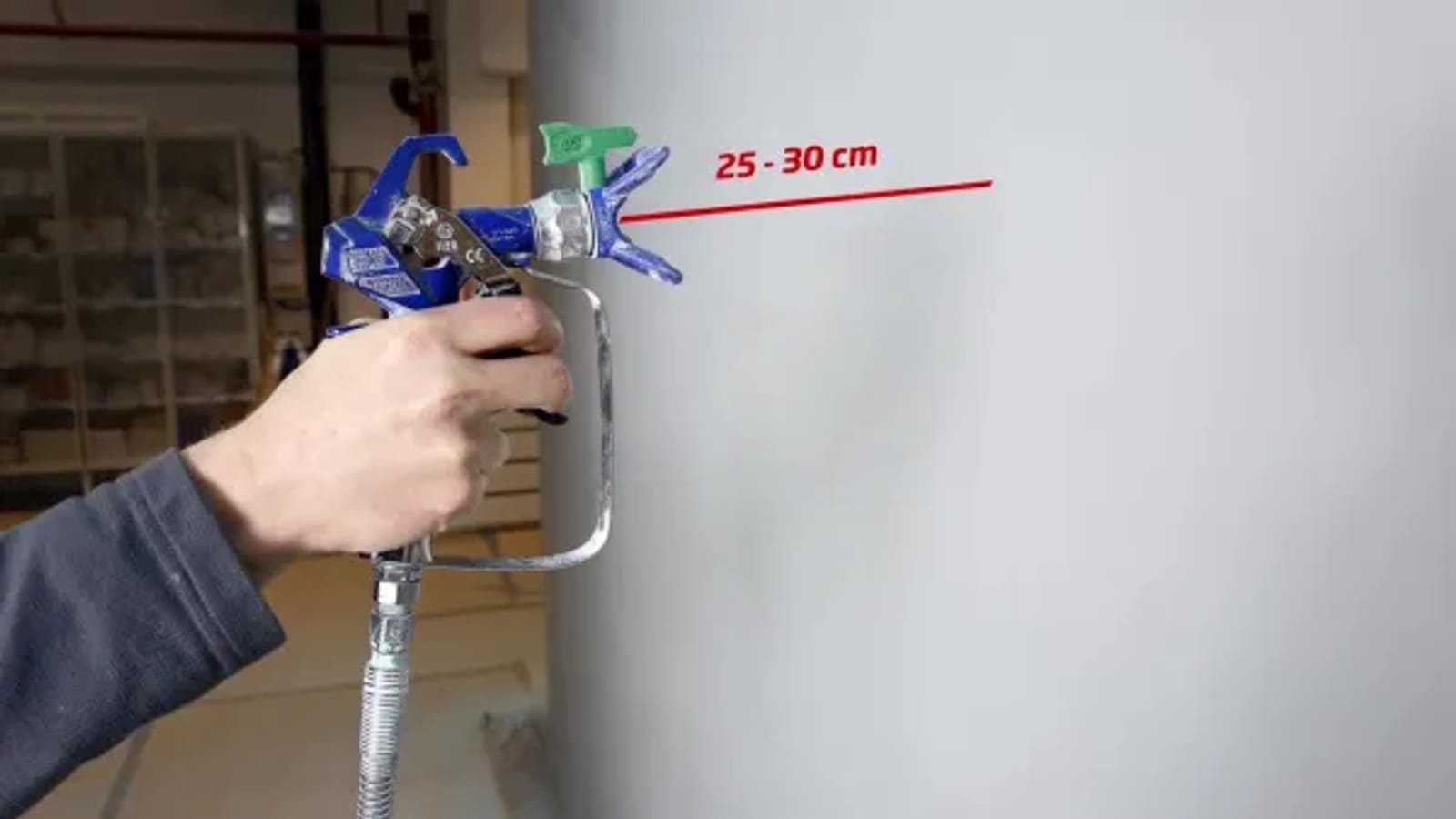
The universal rule across professional sources is simple: run the lowest pressure that still produces a fully atomized, tail-free fan. Lower pressure reduces overspray, saves material, and slows tip wear. Typical starting points for wood finishes sit around 1,500–2,000 PSI, often dialed back toward 1,200–1,800 PSI for a thin lacquer through a 0.013" tip at a 10–14" spray distance — then adjusted up or down in small increments until the pattern's edges stop feathering into tails. Before switching between materials, flushing the system (commonly at a low working pressure) until it runs clear prevents cross-contamination and clogging. GROG hoses are rated to 227 bar and guns to 270 bar, well above typical lacquer and enamel operating pressures, giving margin for pressure adjustments without working near equipment limits. Pair the HP airless hose with a tip guard for safer, more controlled spraying at close range, and an extension pole for raised trim or railings. Watch tip condition closely during fine-finish work — a worn orifice widens the spray pattern and coarsens atomization long before it looks visibly damaged; the tip-wear guide covers the warning signs.
Beyond Straight Airless
When a project demands an even softer edge than a fine-finish tip can deliver, air-assisted airless is the next step up. It partially atomizes the coating through a small orifice and adds a small volume of air to the fan at the gun, softening the pattern further and cutting overspray — a middle ground between airless speed and HVLP-level control, worth considering for high-gloss enamel work where edge quality is non-negotiable.