Airless Paint Sprayer Hose Guide: Diameter, Length and Pressure Loss Explained
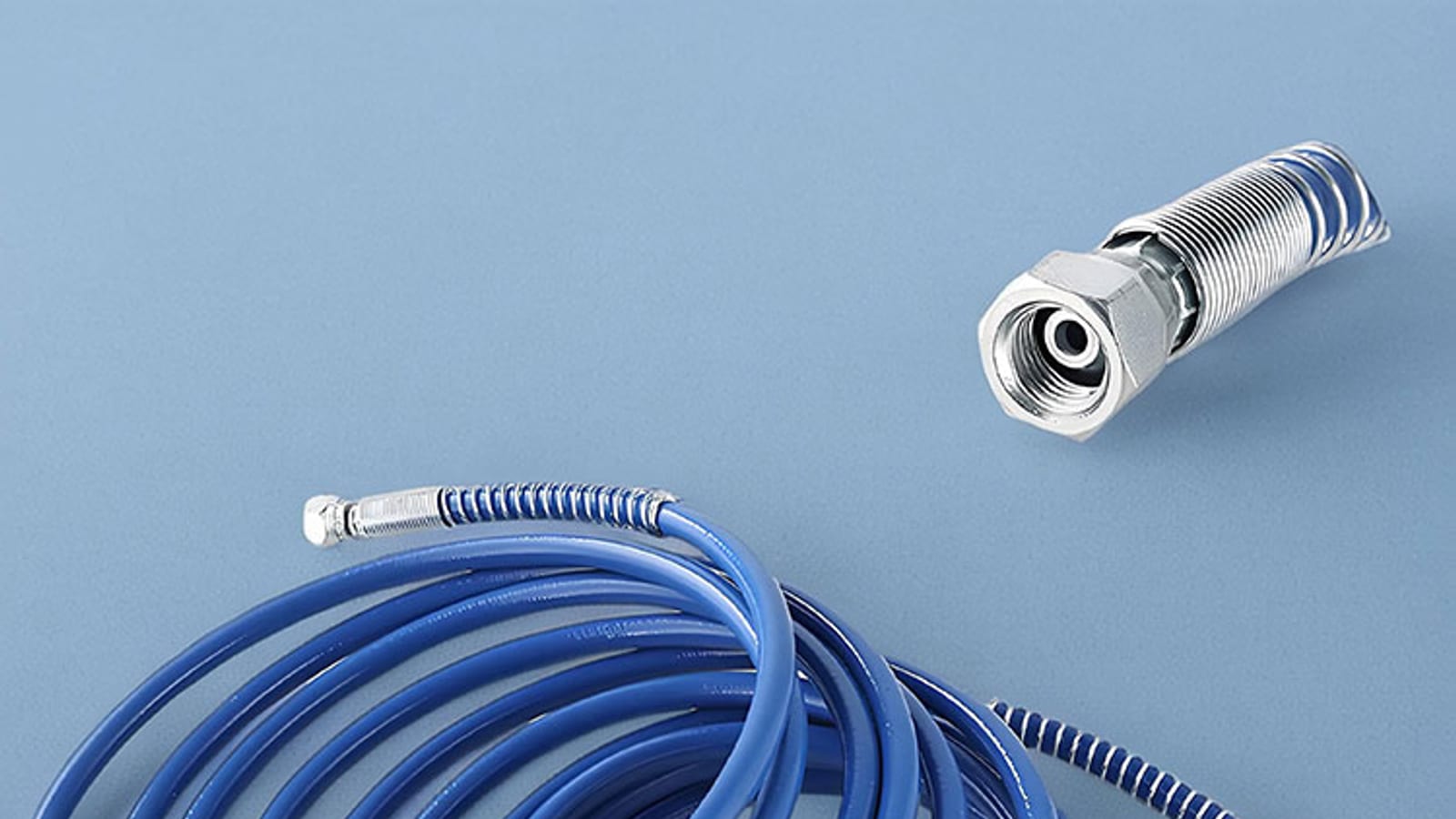
The high-pressure hose is easy to ignore until it costs you a clean fan. It is not just a pipe between the pump and the gun — its diameter and length directly affect how much pressure actually reaches the tip, how heavy a material you can move, and how far from the pump you can work. This guide explains hose diameter, length and pressure loss in practical terms, so you can size a hose to the job instead of guessing.
What the high-pressure hose actually does
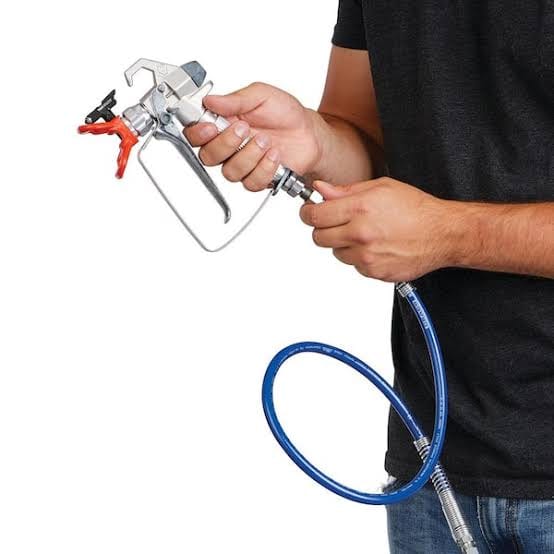
An airless hose carries coating from the pump to the gun at very high pressure and, crucially, keeps that pressure stable so the tip atomises properly. A hose that is too small or too long for the job lets pressure drop along the way, so the gun sees less pressure than the gauge on the machine shows. The result is under-atomisation — tails and a heavy pattern — that no amount of turning up the pump fully fixes. Sizing the hose correctly is therefore part of getting a good finish, not just a convenience.
Airless hoses are specialist, rated components. They are built for the pressures airless generates and carry a marked maximum working pressure. Garden or air hose is never a substitute and is dangerous on an airless system.
Hose diameter: 1/4, 3/8 and 1/2 inch
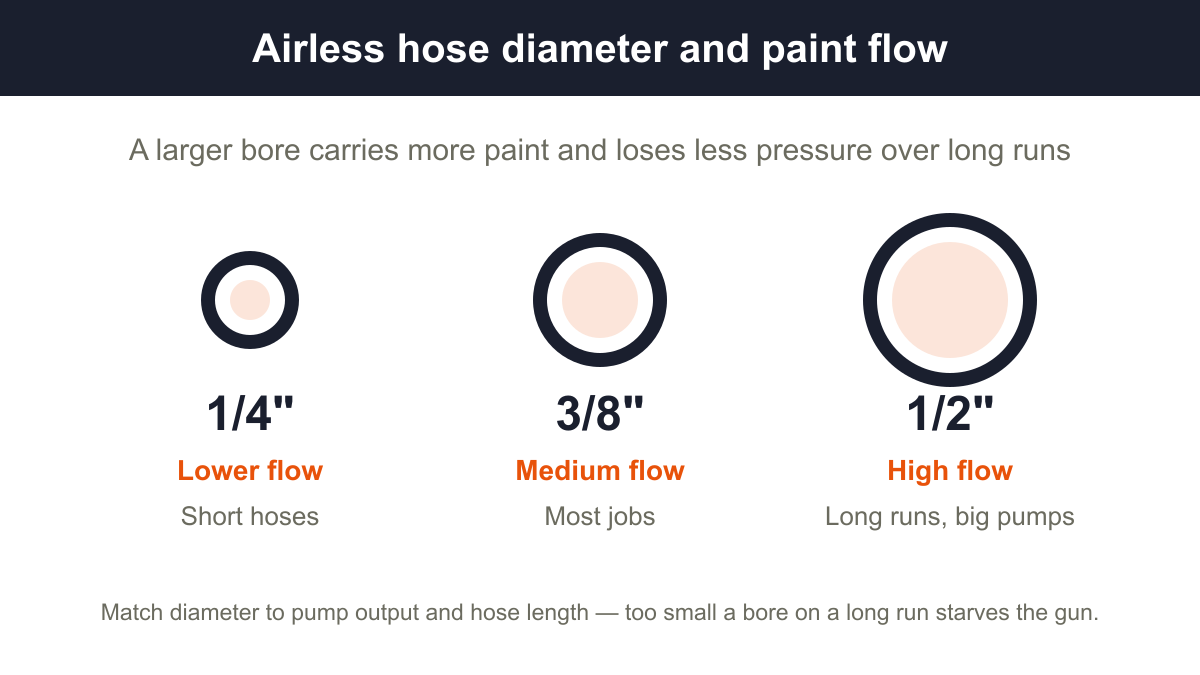
Diameter is the inner bore of the hose. A larger bore lets more material flow with less resistance, which means less pressure lost along the length. The three common professional sizes each have a role:
- 1/4 inch — the standard for smaller machines and shorter runs. Light and easy to handle for interior work and detail, but pressure loss rises quickly as it gets longer or the material gets heavier.
- 3/8 inch — the professional workhorse for longer runs and heavier materials. Much lower pressure loss over distance, at the cost of more weight and stiffness.
- 1/2 inch — for very long runs and high-output machines moving heavy coatings, where keeping pressure at the gun over distance matters more than hose weight.
A common professional setup pairs a larger-bore main hose with a short, thinner leader (whip) hose at the gun. The main hose carries pressure over distance with minimal loss; the short whip restores flexibility at the gun so your wrist is not fighting a stiff, heavy hose all day.
Hose length and pressure loss
Every metre of hose adds resistance, and that resistance shows up as pressure loss between the pump and the tip. Two things increase it: length and material weight. A short hose on thin paint loses very little. A long hose on heavy emulsion can lose a great deal, so the tip is starved even though the pump is working hard. This is why long runs so often produce tailing that will not clear — the tip simply is not receiving the pressure it needs.
The practical fix is diameter, not just pressure. Stepping up one hose size dramatically reduces pressure loss over a long run, and it does so without straining the pump the way constant high pressure does. If you routinely tail out on long hoses, a larger-bore hose usually solves it more cleanly than turning the pump to maximum. For the pressure side of the same problem, see airless spray pressure and pattern adjustment.
Match the hose to the job
The table below connects common jobs to a hose consideration and the reason behind it. Distances such as 10, 15 and 30 m are given as everyday reference points, not as limits — your machine's rated maximum hose length and flow always take priority over any general guidance.
| Job / material | Hose consideration | Why |
|---|---|---|
| Interior walls, short runs (up to ~15 m), standard paint | 1/4 in is usually enough | Light and manoeuvrable; pressure loss stays low over shorter distances. |
| Whole-house interiors, medium runs, primer and wall paint | 1/4 in main with a short whip, or step to 3/8 in for the longer runs | Keeps handling easy while limiting loss as distance grows. |
| Facade and exterior work, longer runs (~15–30 m) | 3/8 in main hose | Much lower pressure loss over distance keeps the fan clean far from the pump. |
| Large commercial areas / high output | 3/8 in, or 1/2 in for the longest runs | Higher flow with stable pressure at the gun over long distances. |
| Scaffolding and multi-storey reach | Larger-bore main hose plus a short whip at the gun | Length is unavoidable; a larger bore offsets the added loss, the whip restores control. |
| Heavy coatings, fillers and putty | Step up a hose size; follow the machine and coating limits | Heavy material multiplies pressure loss, so extra bore matters more than on thin paint. |
| Long-distance spraying beyond your usual reach | Larger bore and confirm the machine's rated maximum hose length | Very long runs can exceed what a small hose — or the pump — can support cleanly. |
The pattern is simple: as distance and material weight go up, so does the case for a larger bore. When in doubt on a long or heavy job, size up the hose before you reach for maximum pressure.
Extensions, joining hoses and fittings
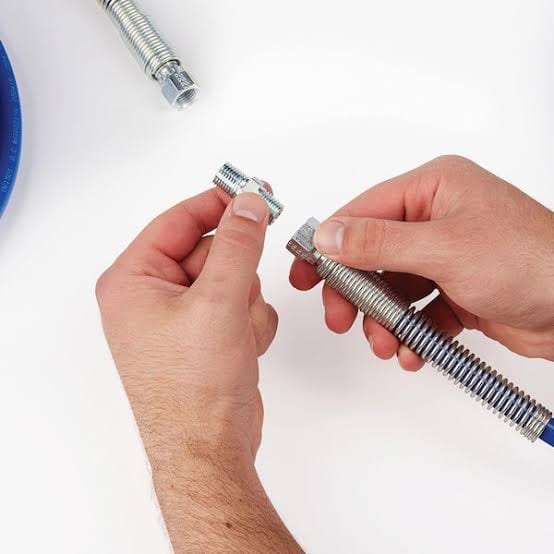
You can add reach by joining a rated extension hose to your main hose with a high-pressure coupling. Every joint must be a proper airless coupling rated to at least the pressure of the hoses it connects, and thread and diameter have to match — a 3/8 in hose joined to a 1/4 in section needs the correct reducing coupling, not an improvised adapter. Keep the number of joints sensible: each fitting is another connection to inspect and another small place where pressure can be lost or a leak can start. Extension hoses, couplings and adapters are listed with the other airless accessories.
When you join hoses, the total length is what drives pressure loss, so a long combined run may still call for a larger main bore even if each individual hose seemed fine on its own.
Pressure rating and compatibility
Every airless hose and coupling carries a maximum working pressure, and you must never exceed the lowest-rated component in the chain. If you connect a hose rated lower than your machine's maximum output, that hose sets the safe limit for the whole system. Check that the hose rating meets or exceeds your sprayer's maximum pressure, that fittings are rated to match, and that the hose is chemically suitable for the coating and solvents you use. Do not mix random fittings of unknown rating.
Inspection and replacement
- Before each use, run the hose through your hands (with the system depressurised) and look for bulges, blisters, cuts, kinks, flat spots or exposed reinforcement.
- Check the fittings at both ends for damage, corrosion and leaks; a weeping fitting is a warning, not a nuisance.
- Replace a hose that is bulging, blistered, cut to the reinforcement, or leaking — never wrap it with tape or try to repair the pressure-carrying layer.
- Avoid tight kinks, running the hose over sharp edges, driving over it or dragging it across abrasive surfaces.
- Store it loosely coiled, out of direct sun and away from solvents that are not compatible with the outer cover.
Treat the hose as a wear item within your overall routine — the airless sprayer maintenance checklist covers where hose checks fit alongside pump, filter and tip care.
Common mistakes
- Fighting tails on a long run with more and more pressure instead of stepping up the hose diameter.
- Running a hose or fitting rated below the machine's maximum pressure.
- Joining mismatched diameters or threads with improvised adapters.
- Ignoring a small leak at a fitting — high-pressure leaks worsen quickly and are a safety hazard.
- Using a non-airless hose, or repairing a damaged high-pressure hose instead of replacing it.
Safety
Airless hoses hold coating at pressures high enough to inject it through skin, which is a medical emergency. Always relieve system pressure before disconnecting or inspecting a hose: switch off, set the pressure to minimum, engage the trigger lock, trigger the gun into a waste container, and follow your machine's pressure-relief procedure. Never try to find a leak by running a hand along the hose, never point the gun at anyone, and never disconnect a pressurised fitting. A pinhole leak in a high-pressure hose is especially dangerous because the escaping jet is nearly invisible — if you suspect one, depressurise and replace the hose. Where a manufacturer specifies grounding or an anti-static hose for solvent-based work, follow that guidance.
Size the hose to the distance and the material, keep every component within its pressure rating, and let your machine and coating manufacturers' figures override the general reference points here. With the tip, filter and hose all matched to the job, your sprayer can deliver the clean, consistent finish it is capable of. For the tip-and-filter side of the setup, see the airless spray tip and filter guide.