Filler machine guide: machine-applied filling explained
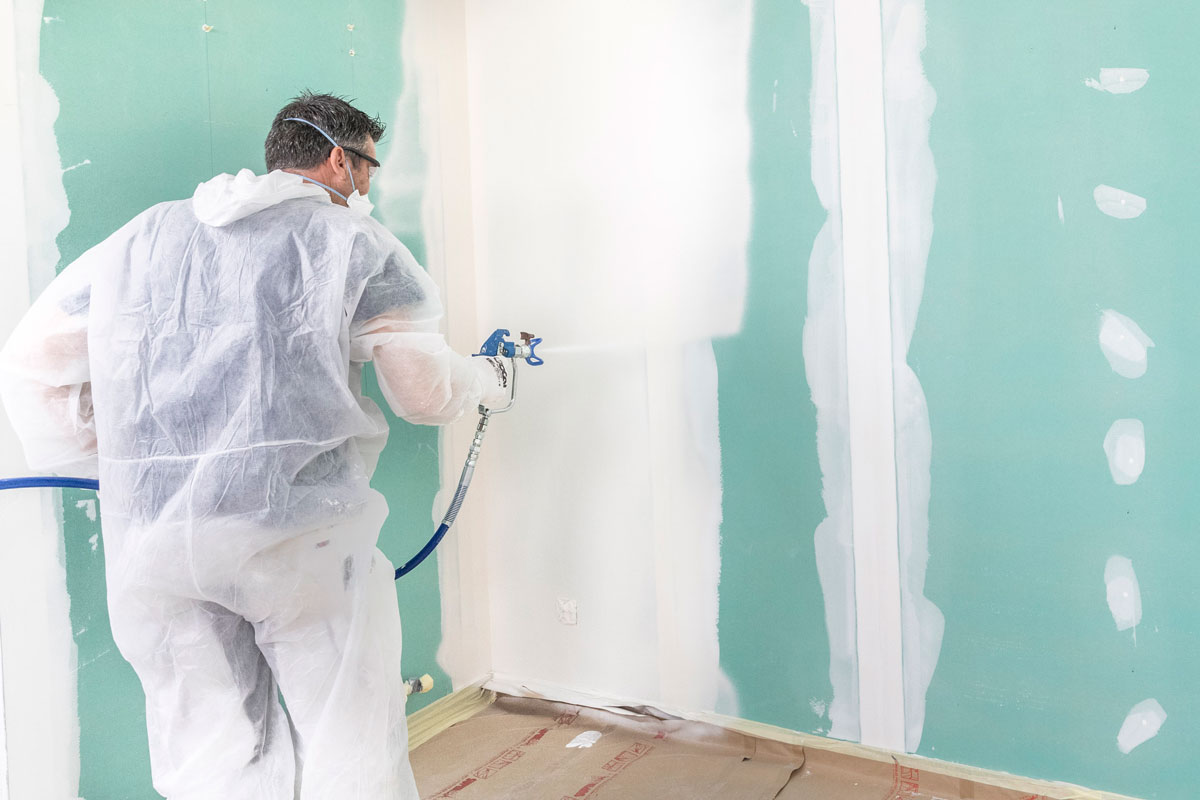
Filling large surfaces by hand is hard, slow work. On big interior and drywall projects, manually filling walls and ceilings eats up time and strains backs, shoulders and wrists. A filler machine applies the compound mechanically instead — evenly, fast and in a consistent layer thickness. For drywall fitters, painters and renovation firms it is often the investment that makes a whole workflow profitable.
This guide explains what a filler machine does, the machine types available, what to check before buying, and when the purchase pays off. If you already know you want an airless unit, you will find a direct model comparison further down.
What is a filler machine?
A filler machine pumps paste-like materials — filler, joint compound, surface filler — under pressure from the bucket through a hose to the gun, and sprays them onto the surface as an even film. Unlike conventional paint spraying, this is not about thin paint but about highly viscous, thick materials, which place very different demands on the pump, pressure and tip.
In today's dominant airless technology, a piston pump generates very high material pressure — up to around 227 bar on professional units. The material is atomised by that pressure alone, without compressed air, hence "airless". That high pressure is exactly what is needed to push viscous filler cleanly through a large tip. Modern electric airless units cover both filling and paint spraying when the machine is built for it.
After machine application, the compound is usually pulled off with a trowel or blade. The machine does not replace the finishing — it replaces the exhausting, slow application, which is the step that consumes most time on large surfaces.
What types of filler machines exist?
Not every machine that handles filler works the same way. In practice you meet three principles:
| Machine type | Principle | Strengths | Typical use |
|---|---|---|---|
| Airless piston pump | Piston builds high material pressure, atomised at the tip | High pressure, handles viscous material, often a combo unit for paint and filler | Drywall, interior fit-out, painters |
| Worm/plaster machine | Feed screw transports material, air atomisation | Very high throughput, also grainy plasters | Large plaster areas, facades |
| Diaphragm pump | Diaphragm moves thinner materials | Cheap, light | Mostly paint and primer, less thick filler |
For classic surface filling in drywall and interior work, the electric airless piston pump is the standard professional tool: compact enough for the site, strong enough for spray filler, and often flexible for primer and paint too. Worm plaster machines only show their strength on very large plaster areas and grainy materials.
Who benefits from machine filling?
- Drywall fitters: filling plasterboard (Q3/Q4 surfaces, joints, full skim) gives the biggest time saving. The larger the continuous area, the bigger the lead over hand work.
- Painters: levelling old walls or applying surface filler for high-grade coatings benefits from the even layer thickness.
- Renovation firms: on empty-flat refurbishment with many square metres, the technology pays off quickly.
- Plasterers: for smooth skim coats alongside plaster work.
For occasional use on a few square metres, hand filling stays more economical — cleaning the machine also takes time. From regular, larger areas onward the maths clearly favours the machine.
Machine filling step by step
Knowing the sequence helps you plan material, time and cleaning realistically. In practice, machine filling consists of these steps:
- Prepare the substrate: clean surfaces, prime absorbent substrates, mask adjacent components and floors.
- Mix the material: prepare the filler per the manufacturer's data or stir ready-mixed compound — consistency decides pumpability.
- Set up the unit: suction system into the bucket, choose the tip, dial in pressure and pattern on a test area.
- Apply: spray in even, overlapping passes — constant pace and distance give an even layer thickness.
- Pull off and smooth: pull the applied compound off with a blade or trowel, reworking wet-on-wet where needed.
- Clean: thoroughly flush pump, hose, gun and tip immediately after use.
The real time saving comes in the "apply" step. In the classic two-person workflow one person sprays ahead and one pulls off directly behind, so the machine moves continuously across the surface without anyone waiting on mixing or refilling. That division of labour is what creates the speed advantage over hand filling.
What to check before buying
The key point first: not every airless unit can handle filler. A light paint sprayer is built for thin materials and small tips and fails on viscous compound. Watch these points:
Checklist: choosing the right filler machine
- Flow rate: at least 4 L/min, ideally 6 L/min for fast surface filling.
- Pressure: high maximum pressure (around 220 bar and up) for clean atomisation of viscous material.
- Pump type: piston pump for high-viscosity materials — not a weak diaphragm pump.
- Tip size: the unit must supply large tips from about 0.035″.
- Hose: adequate inner diameter (3/8″ ≈ 10 mm, 1/2″ ≈ 13 mm for very thick material).
- Motor power: a strong motor (several kW) that holds pressure even with a large tip.
- Cleaning and maintenance: an easily stripped pump — filler must be fully flushed out.
- Kit: a matching filler gun, high-pressure hose, tips and extension.
Buying too small leads to clogging and a poor spray pattern. Plan around 20 % power reserve above what your standard material theoretically needs.
Which materials can be machine-applied?
- Surface filler (Q3/Q4 in drywall)
- Spray filler and ready-mixed compound
- Primers and deep primer
- Thinner plasters (with the right machine)
- Fire-protection coatings (on powerful machines)
Decisive is always the viscosity of the specific material and the manufacturer's data. Very thick compounds need larger tips and higher pressure — and therefore a correspondingly strong machine. Always check the material data sheet against the machine's output.
Cleaning and maintenance: the essentials
No other factor affects a filler machine's lifespan as much as cleaning. Compound that dries inside the pump, hose or tip is the most common cause of damage. Flush the unit immediately after use — not after the next break.
- Pump residual material back into the bucket, then flush with water (for water-based compounds) until it runs clear.
- Clean the tip and tip guard separately — material sets fastest here.
- Check and clean the suction and gun filters.
- Inspect moving parts and seals regularly; replace wear parts in good time.
- Use a preservative per the manufacturer's data during longer downtimes.
A thorough clean takes a few minutes; a blocked or damaged pump section takes hours — and may cost spare parts. Make this routine a fixed part of every working day. A short function check before the next job also helps: if the pump bleeds cleanly and the unit holds pressure on a test area, you catch faults before they cost time on site.
Cost overview: when does a filler machine pay off?
Profitability depends almost entirely on area per year and saved labour time. A rough orientation:
| Usage profile | Area per month | Economics |
|---|---|---|
| Occasional | a few m² | Hand filling usually cheaper |
| Regular small projects | medium areas | Machine pays off after a few projects |
| Drywall/renovation firm | large areas | Machine pays off fast, time saving dominates |
The biggest lever is not material cost but labour time: when two workers apply a large area in a fraction of the time, that beats any equipment calculation. Add the more even quality, which saves time again during finishing and sanding.
Common mistakes in machine filling
- Buying too weak a unit — a paint sprayer with a small tip clogs on filler immediately.
- Wrong tip — too small: clogging; too large for the output: pressure drop and poor pattern.
- Mixing the material too thick — ignoring the consistency spec causes feed problems.
- Hose too thin or too long without reserve — pressure drops, material comes in bursts.
- Insufficient cleaning — dried filler residue is the most common cause of pump damage.
- No power reserve planned — machines run at the limit wear out faster.
Which GROG machine suits filling?
For machine filling, the GROG F4L is the right unit in the GROG range. It is built as an electric airless plastering and filling machine — with exactly the combination of pressure, flow and tip size that viscous filler demands.
| Model | Pressure | Flow rate | Max tip | Motor | Built for |
|---|---|---|---|---|---|
| GROG F4L | 227 bar | 6 L/min | 0.035″ | 3800 W | Filler, plaster, render, fire-protection |
| GROG AZ700 | 227 bar | 4 L/min | 0.031″ | 4200 W | Paint, primer, emulsion, lacquer |
| GROG AZ600 | 227 bar | 3 L/min | 0.025″ | 3500 W | Paint, primer, emulsion, lacquer |
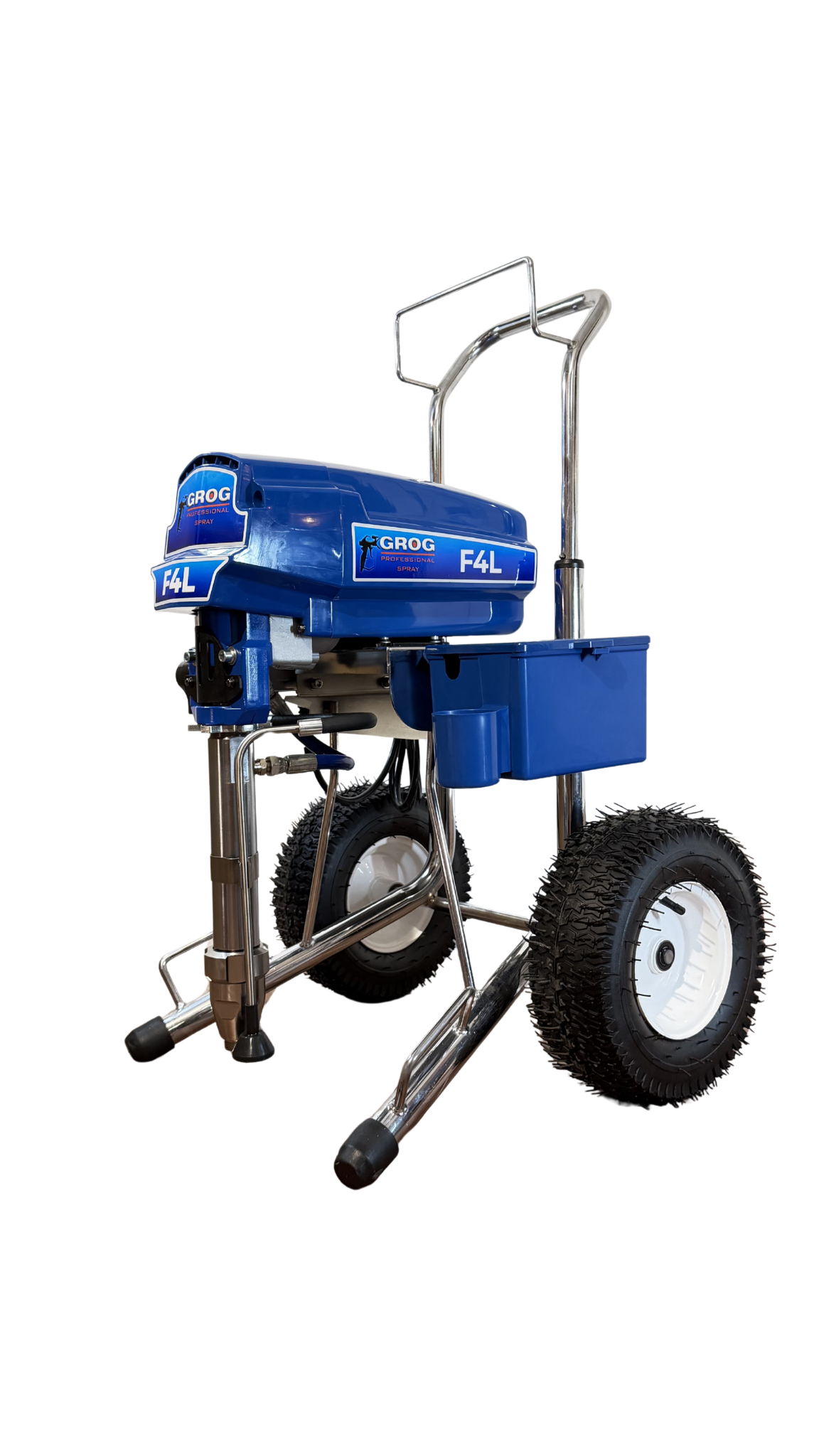
With 6 L/min at 227 bar and tips up to 0.035″, the F4L provides exactly what thick compounds require. The 3800 W motor holds pressure even with a large tip, and the kit — filler gun, high-pressure hose, tips and telescopic extension — is matched to filling work.
By contrast, the GROG AZ600 and GROG AZ700 are paint sprayers for walls, ceilings and facades — primer, emulsion and lacquer. They are lighter and more mobile, but with tips up to 0.025″ and 0.031″ and lower flow they are not meant for thick filler. If you need both, weigh your material focus honestly: for filler, a stronger unit like the F4L is the way to go.
For a detailed model comparison for filler and plaster, see our guide on the best airless machine for filler and plaster.
Frequently asked questions (FAQ)
Can you spray filler with airless?
Yes — provided the unit is strong enough. Filler is highly viscous and needs a piston pump with high pressure, sufficient flow and a large tip. A light paint sprayer is not suitable.
What flow rate is needed?
For filler, at least 4 L/min, ideally 6 L/min for fast work on large areas. Flow must match the tip size, otherwise pressure drops.
Which tip do you need for filler?
Thick compounds need large tips from about 0.035″. The exact size depends on the material — thicker and grainier means a larger tip and more required output.
When does a filler machine pay off?
As soon as you regularly fill larger continuous areas. The saved time and labour quickly exceed the equipment cost. For rare small areas, hand work stays cheaper.
What pressure is required?
Viscous filler needs high material pressure so the unit can feed the large tip. Professional machines run at a high maximum pressure — the GROG F4L, for example, at up to 227 bar. The key is that pressure stays stable with a large tip and does not drop.
How do you clean a filler machine properly?
Right after use: pump residual material back, then flush the system with water (for water-based compounds) until it runs clear. Clean the tip, filters and gun separately. Dried residue is the most common cause of pump damage.
Can a filler machine also spray paint?
Many airless piston units are combo machines and handle primer and paint as well as filler — with the right, smaller tip. The reverse is not true: a light, paint-only sprayer cannot handle thick filler.
Conclusion
A filler machine is not a luxury but a real productivity lever on larger areas: faster application, more even layer thickness, less physical strain. The key is correct sizing — piston pump, enough pressure, at least 4 to 6 L/min flow and a matching tip. Plan enough reserve and the unit runs trouble-free for years. In the GROG range, the GROG F4L is built for filler and plaster, while the AZ600 and AZ700 excel at paint spraying. For an overview of all units, see the electric airless category.