Plaster sprayer guide: spray plaster instead of rolling
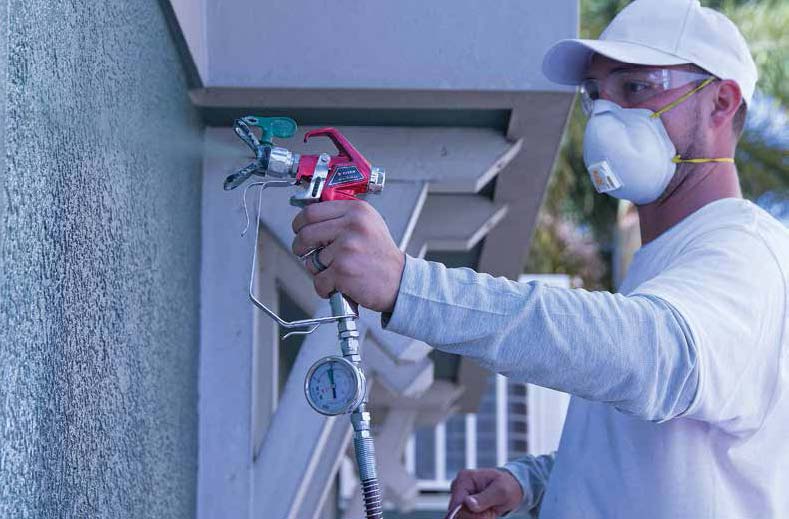
Applying plaster by hand is slow and tiring. A plaster sprayer applies plaster, filler and thick wall materials by machine — over large areas, evenly and in a fraction of the time. For painters, plasterers, facade and renovation firms the question is rarely whether, but which unit fits their material range. That is exactly what this guide settles.
We show how a plaster sprayer works, which plaster types can actually be sprayed, how interior and facade use differ, and what to check before buying. For a step-by-step plaster application, see our post on spraying plaster with an airless machine.
What is a plaster sprayer and how does it work?
A plaster sprayer pumps the material under pressure from the bucket through a hose to the gun and atomises it at the tip. In airless technology a piston pump builds the required high pressure — up to around 227 bar on professional units — and atomises the plaster without compressed air, through the tip alone. This produces an even application that is then pulled off, floated or structured depending on the plaster type.
Note: plaster and thick wall materials demand more than thin paint. A unit for plaster needs more pressure, more flow and a larger tip than a pure wall-paint sprayer. Modern electric airless units cover paint, plaster and filler depending on their design.
Which plaster types can be sprayed?
Not every plaster sprays equally well. Rule of thumb: the finer and thinner the material, the easier; coarse and very viscous plasters need a strong unit and a large tip.
| Plaster type | Sprayability | Machine requirement |
|---|---|---|
| Roll/float plaster (fine) | sprays well | medium flow, medium tip |
| Textured/rough render | sprayable with a large tip | high flow, large tip |
| Mineral/silicate plaster | sprayable, material-dependent | strong piston pump, high pressure |
| Emulsion/facade paint | sprays very well | lower flow is enough |
| Filler | sprayable with a filler unit | highest flow, very large tip |
Always check the data sheet: the manufacturer states whether the material is machine-applicable and which tip and pressure ranges are recommended.
Plaster sprayer: airless or other systems?
For thick plasters, fillers and wall paint, the electric airless method is the common choice: compact, site-ready and usable without a separate compressor. Worm plaster machines with an air tip are the alternative for very large plaster volumes and grainy materials but need more logistics. For the typical painting and renovation firm the electric airless unit is usually the more flexible tool because it covers plaster, primer and paint.
Interior and facade — different requirements
Interior
Indoors, mobility, a clean spray pattern and good dosing matter. Roll plasters, fine textured plasters and primers are common. A handy, not-too-heavy unit with medium flow is ideal here.
Facade
On the facade it is about area and throughput: large continuous walls, often rough render or facade paint. High flow and reach (long hoses, extension) pay off. Thick mineral plasters need a strong unit with a large tip.
Spraying plaster step by step
A clean result depends less on the unit than on the sequence. This order has proven itself in practice:
- Check and prepare the substrate: clean, sound, dry; prime absorbent surfaces.
- Mask and cover: protect windows, doors, floors and adjacent areas.
- Mix the material: prepare the plaster per the data sheet, check consistency and adjust as needed.
- Choose the tip and dial it in on a test area: pressure as low as possible, as high as necessary.
- Apply in even, overlapping passes: constant distance and pace.
- Re-texture if needed, then clean the unit immediately.
Texturing after spraying
Many plasters are textured by hand after machine application. Spraying does not replace the styling — it speeds up the material application. Depending on the desired look, different techniques are used:
- Floating: a float board creates an even float-plaster texture.
- Felting: a felt board makes the surface finer and more closed.
- Pulling/smoothing: for smooth surfaces the compound is pulled off with a trowel.
- Combing or modelling: for decorative textures and patterns.
Work quickly and wet-on-wet so no visible joins appear. On facades especially, finish a continuous area in a single pass — otherwise transitions show in the finished plaster.
Which accessories belong with a plaster sprayer?
The unit alone does not make a good surface. Correctly matched accessories matter — especially with thick material:
- High-pressure hose with adequate inner diameter (3/8″ to 1/2″ for thick plasters) and the right length for reach.
- Tips in several sizes, matched to the material range from fine to coarse.
- Tip guard and a robust gun built for viscous materials.
- Extension for ceilings, high walls and the facade.
- A capable suction/intake system that reliably feeds thick material.
What to check before buying (checklist)
- Flow rate: at least 3 to 4 L/min for plaster, around 6 L/min for thick plasters and filler.
- Pressure: high maximum pressure (around 220 bar and up) for clean atomisation of viscous material.
- Pump type: piston pump for thick plasters.
- Tip choice: suitable tip sizes for the planned material — coarse plasters need large tips.
- Hose and reach: adequate inner diameter and length, especially on facades.
- Weight and mobility: more important indoors, secondary on facades.
- Cleaning: easy to flush — plaster must not dry inside the pump.
- Kit: gun, high-pressure hose, tips and extension.
Spray or roll? The time and cost comparison
Spraying is more expensive at first due to equipment, but on large areas it is usually faster and more economical than rolling or brushing.
| Criterion | Spraying (airless) | Rolling / brushing |
|---|---|---|
| Speed | much faster on large areas | slower, limited area |
| Evenness | very even layer | depends on the operator |
| Preparation | masking required | little preparation |
| Cost | equipment investment, then cheap per m² | cheap tools, high time cost |
| Suitability | large areas, plasters, facade | small areas, touch-ups |
Common mistakes when spraying plaster
- Too weak a unit for the chosen plaster — pressure drops, material comes in bursts.
- Wrong or too-small tip for coarse plaster — clogging.
- Substrate not prepared or primed — poor adhesion.
- No clean masking — overspray on windows, floors and adjacent areas.
- Unfavourable weather on facades (sun, wind, rain) — uneven drying.
- Machine not thoroughly flushed after use — plaster residue clogs the pump.
Cleaning, maintenance and safety
Plaster is abrasive and must not dry inside the unit. Clean the pump, hose, gun and tip right after use until the flush water runs clear, and check the filters. Wear parts such as the tip and seals are stressed more by plaster than by paint — inspect them regularly and keep spare tips on hand.
Do not underestimate safety: airless units work at very high pressure. The jet can inject material under the skin — a serious injection injury. Never point the gun at people, engage the trigger lock during breaks, and release the pressure before any maintenance. Wear safety glasses, gloves and respiratory protection, especially with mineral plasters and indoors.
Recommended GROG units for spraying plaster
Which GROG unit fits depends on the material. For thick plasters, mineral materials and filler the GROG F4L is the workhorse; for facade and wall paints and thinner coatings the AZ700 and AZ600 paint sprayers are the right choice.
| Model | Pressure | Flow rate | Max tip | Motor | Recommended for |
|---|---|---|---|---|---|
| GROG F4L | 227 bar | 6 L/min | 0.035″ | 3800 W | thick plaster, mineral, filler |
| GROG AZ700 | 227 bar | 4 L/min | 0.031″ | 4200 W | facade paint, large areas |
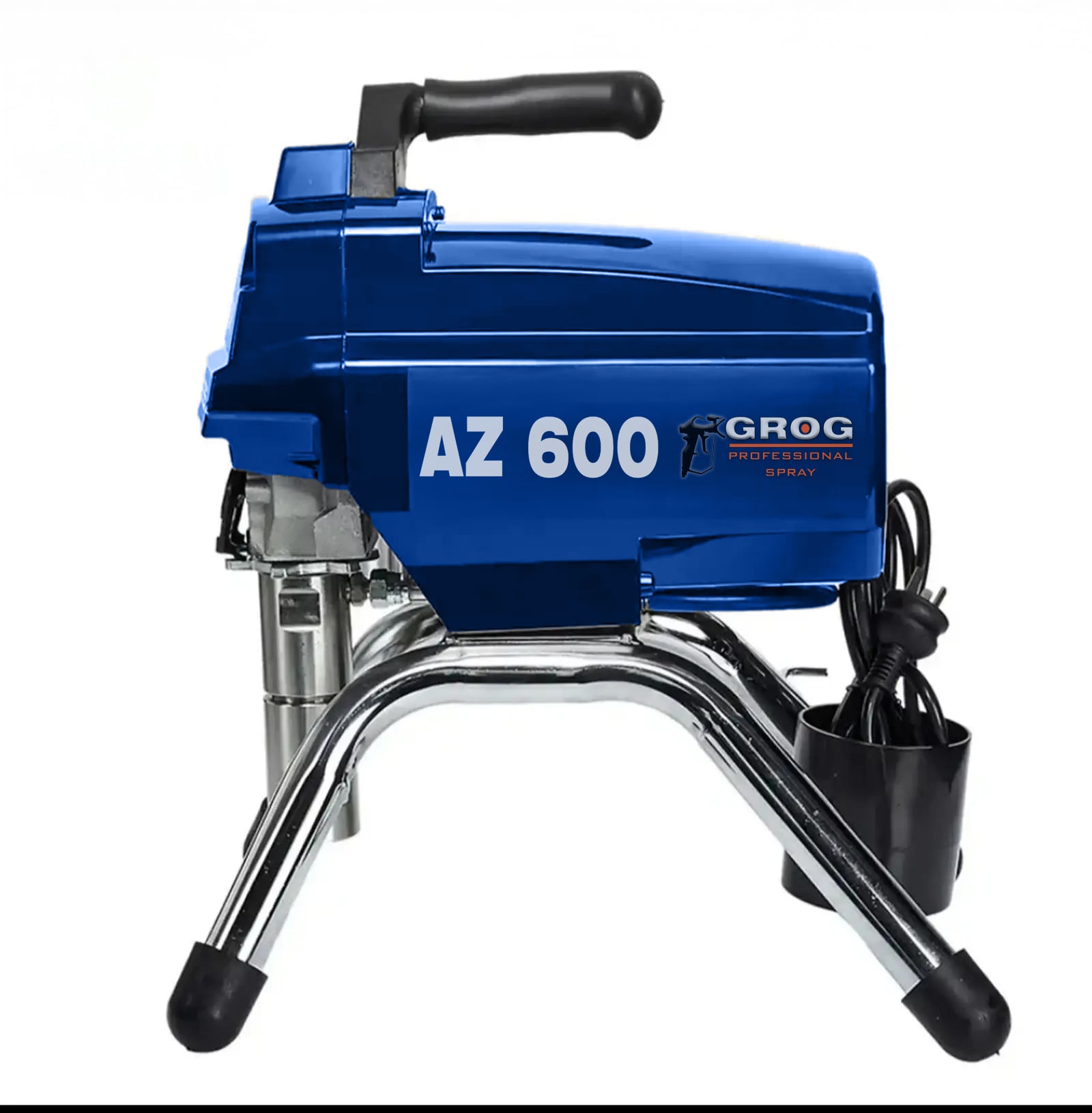
| GROG AZ600 | 227 bar | 3 L/min | 0.025″ | 3500 W | interior walls, primer, wall paint |
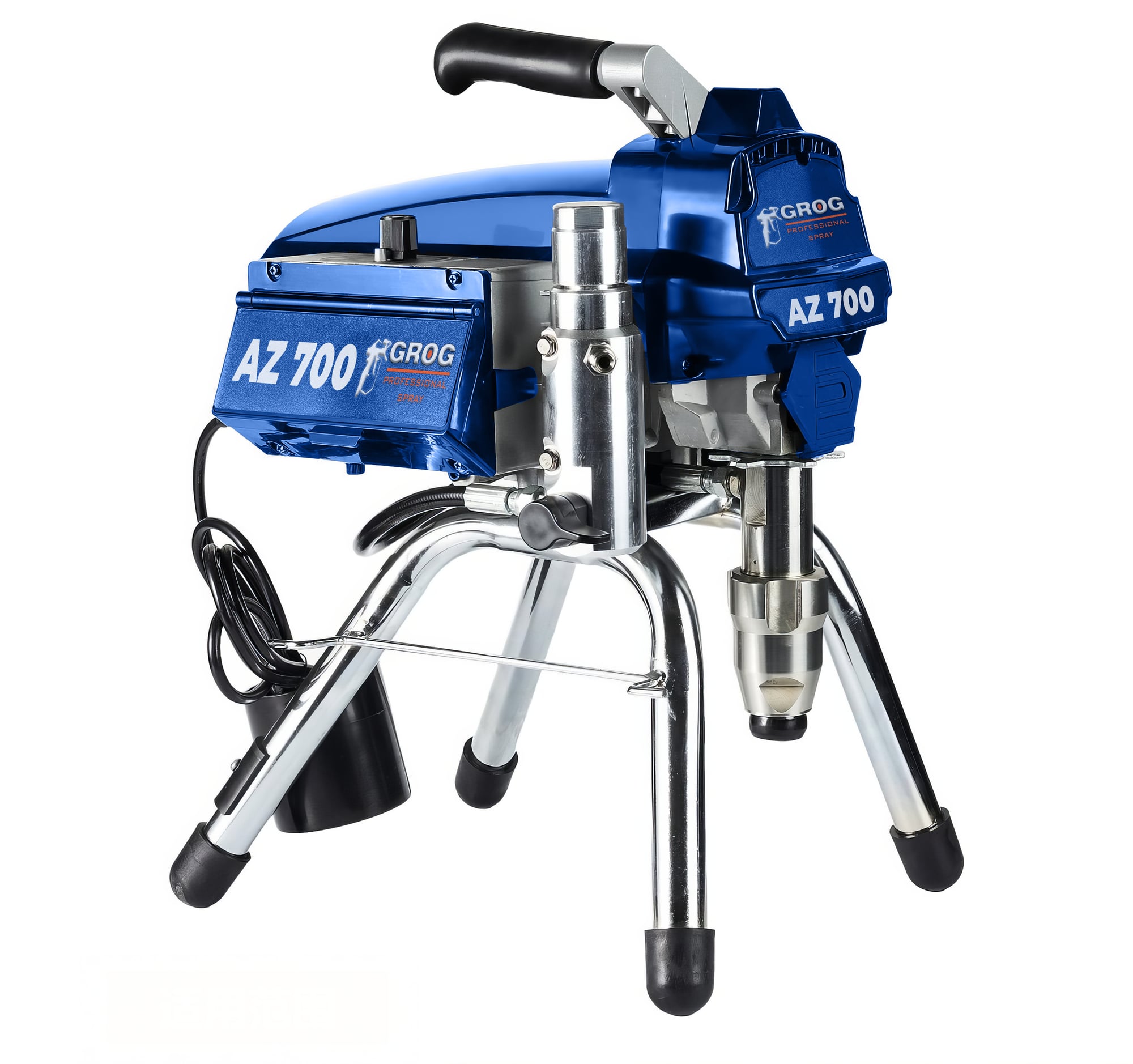
The GROG F4L delivers 6 L/min at 227 bar and feeds tips up to 0.035″, so it also handles viscous and mineral plasters; its 3800 W motor holds pressure with a large tip. The GROG AZ700 with 4 L/min and 4200 W is the unit for facade paint and large walls; the lighter GROG AZ600 with 3 L/min and just 25 kg suits interior walls, primers and wall paint.
Frequently asked questions (FAQ)
Can you spray plaster with airless?
Yes. Many plasters — from roll plaster and rough render to mineral plasters — can be sprayed with a strong enough airless unit. Flow, pressure and the right tip for the material are decisive.
Which unit for rough render or interior plaster?
Coarse rough render needs high flow and a large tip — a strong unit like the F4L fits. For finer interior plasters and wall paint, a paint sprayer like the AZ600 or AZ700 is enough.
What flow rate is needed for plaster?
For thinner plasters and facade paint, 3 to 4 L/min is often enough. Thick mineral plasters and filler need more — towards 6 L/min and a large tip.
Spray or roll — which is faster?
On large areas spraying is much faster and more even. The extra masking effort pays off above a certain area almost every time.
Which tip do you need for plaster?
It depends on the plaster: fine roll and textured plasters run with medium tips, coarse rough render needs a large tip. Rule of thumb: the coarser and thicker the material, the larger the tip — and the more flow the unit must supply. The data sheet states the recommended range.
Do you have to thin plaster for spraying?
Only if the manufacturer allows it. Many spray plasters are already set for machine application. Over-thinning worsens coverage and texture — stick to the data sheet.
How do you clean the plaster sprayer?
Right after use: pump residual material back and flush the system with water until it runs clear. Clean the tip, filters and gun separately. Drying plaster residue is the most common cause of clogging and pump damage.
Conclusion
A plaster sprayer saves a lot of time on large areas and gives a more even application than hand work. The right choice depends on the material: fine plaster and wall paint are less demanding than coarse render or mineral plasters. If you process thick plasters, reach for the GROG F4L; for facade and wall paints the AZ700 and AZ600 are the units to pick. For the full overview, see the electric airless category.