Airless vs Roller vs Brush: Which Painting Method Is Best?
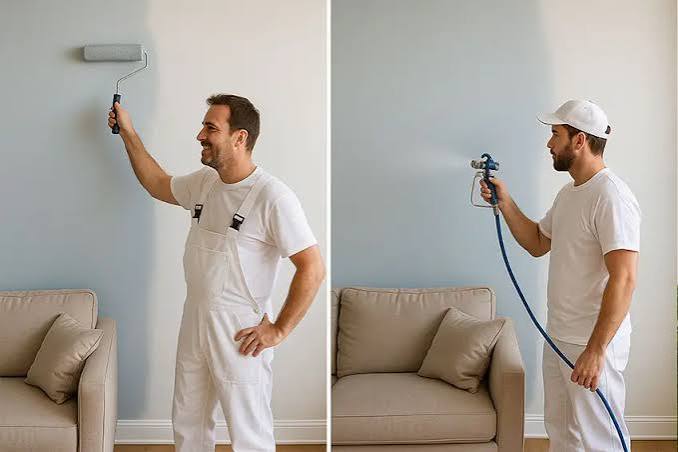
Ask ten experienced painters which application method is best and you will get a version of the same answer: it depends on the job. Airless spraying, rolling and brushing are not really competitors - they are three tools that each win in different situations. The problem is that the wrong choice quietly costs money on every project, either in wasted hours, wasted paint, or a finish that has to be redone.
This guide compares the three methods across the factors that actually affect a working painter: speed and productivity, finish quality, paint consumption, labour cost, surface suitability and the practical realities of professional use. The goal is not to crown a single winner, but to give you a clear framework for deciding which method - or which combination - fits the work in front of you.
How each method works
Before comparing performance it helps to be precise about what each tool actually does, because the differences in mechanics explain the differences in results.
Brushing
A brush drags a controlled amount of paint across the surface and works it into the substrate with the bristles. That mechanical action is its great strength: it pushes coating into grain, joints, pores and corners, and it gives the painter fine control over exactly where the material goes. The trade-off is throughput. A brush moves paint centimetres at a time, so it is slow on anything larger than trim and detail.
Rolling
A roller transfers paint from a tray or feed to the wall through an absorbent sleeve. It covers far more area per stroke than a brush and leaves a characteristic light texture, or stipple, that many specifications actually call for. Rolling is forgiving, cheap to set up and produces very little airborne mist, which makes it the default for occupied interiors and small rooms.
Airless spraying
An airless sprayer uses a pump to force paint through a small tip at very high pressure - commonly 150 to 230 bar. The pressure alone breaks the paint into a fine fan of droplets, with no compressed air involved. That is why airless equipment can move enormous volumes of material onto a surface in seconds and build an even film with no brush marks or roller texture. The cost is overspray, masking and a steeper learning curve.
Speed and productivity
Speed is the headline reason crews invest in spray equipment. On large, uninterrupted surfaces - facades, warehouse walls, ceilings, fencing, new-build interiors before fit-out - an airless sprayer is in a different league. A single operator can lay down in an hour what would take most of a day with a roller.
But raw application speed is only part of the picture. Real productivity is application time plus preparation, masking, setup and cleaning. Spraying front-loads a lot of that overhead: you mask everything you do not want painted, set up the machine, prime the lines and flush the system afterwards. On a big open job that overhead is trivial compared with the time saved. On a small, cluttered job it can wipe out the advantage entirely.
- Large open surfaces: airless spraying wins decisively - often 4 to 10 times faster than rolling.
- Medium rooms with some furniture and trim: rolling is frequently faster once masking is counted.
- Trim, edges and small repairs: brushing is fastest because there is no setup at all.
- Repetitive production work such as doors, fences or radiators: spraying wins as volume grows.
A useful rule of thumb: the larger and more continuous the surface, the more spraying pays off. The more broken-up and detailed the work, the more a brush or roller earns its place.
Finish quality
Finish is where opinions get strong, so it is worth separating fact from preference. A properly dialled-in airless sprayer produces the flattest, most uniform film of the three. There are no brush marks, no roller stipple and no lap lines when the technique is right. For high-gloss doors, cabinetry, smooth ceilings and any surface where a mirror-flat result is specified, spraying is hard to beat.
Rolling leaves a fine, even texture. On walls that is usually a feature rather than a fault - it hides minor imperfections and gives a consistent look that is easy to touch up later. Brushing leaves the most visible texture and, in the wrong hands, marks and drips; but a skilled brush hand on trim produces a crisp, controlled line that no other method matches.
The catch with spraying is that a flawless sprayed finish depends on preparation, tip choice, pressure and a steady hand. A poorly set-up sprayer produces tails, fingers, runs and uneven coverage faster than any other tool. The finish ceiling is higher, but so is the floor.
Paint consumption and waste
This is the factor most often ignored when crews compare methods, and it matters because paint is frequently the single largest material cost on a job. Brushing is the most economical: almost every drop that leaves the brush ends up on the surface. Rolling is close behind, with modest loss to the tray and sleeve.
Spraying uses the most material. Some paint is lost as overspray that never reaches the surface, and a sprayed coat tends to build a slightly heavier film per pass. As a working estimate, spraying can consume roughly 15 to 40 percent more paint than rolling the same area. Technique moves that number a lot: the right tip size, correct pressure, a controlled spray distance and disciplined overlap keep waste near the bottom of the range, while excessive pressure and an oversized tip push it to the top.
For expensive coatings - two-pack products, intumescent paints, specialist finishes - that consumption gap can quickly outweigh the labour saved by spraying. On cheap emulsion over a huge area, the labour saving wins easily. Run the numbers per job rather than assuming.
Labour cost
Labour is usually the biggest line on a professional quote, which is why speed and labour cost are tightly linked. Because one operator with a sprayer can cover the ground of several people rolling, spraying lowers labour cost per square metre on large jobs - even after accounting for masking and cleanup. On production work the effect compounds: the more repeated surfaces you spray, the cheaper each one becomes.
The balance flips on small and detailed work. Masking a small, complicated space can take longer than simply cutting in and rolling it, so the labour advantage of spraying disappears. This is why experienced estimators think in terms of the whole workflow rather than application speed alone.
Surface and material suitability
Not every surface or material suits every method. Matching the tool to the substrate avoids both poor results and unnecessary effort.
| Surface or situation | Best primary method | Why |
|---|---|---|
| Large flat walls and ceilings | Airless spray, often back-rolled | Speed and even film; back-rolling adds bond and texture |
| Facades and exterior render | Airless spray | Huge area, fast build, reaches texture |
| Trim, frames and narrow edges | Brush | Control and clean lines beat speed here |
| Occupied interiors and small rooms | Roller with brush cut-in | Minimal masking and overspray |
| Doors, fences, railings, radiators | Airless spray | Repetitive shapes, smooth finish, high volume |
| Rough or porous substrates | Brush or back-roll | Mechanical working forces paint into the surface |
| Fine furniture and cabinetry | Airless spray (fine tip) | Mirror-flat finish with no marks |
Material matters too. Thin, low-viscosity coatings atomise and spray beautifully. Thick, high-build or heavily textured products may need a larger tip, higher pressure and a machine with the output to match - which is exactly where a well-sized electric airless unit earns its keep, and where an undersized one struggles. If you regularly spray heavier materials, choose equipment rated for the flow and pressure those products demand rather than the cheapest machine that technically sprays.
The professional reality: use all three
In practice the best painters do not choose one method for a whole project. They combine them. A typical high-quality job might brush the cut-in and detail, spray the large surfaces for speed and a flat film, and back-roll the sprayed coat where a mechanical bond or a specified texture is needed. Each tool does the part it does best, and the finished result is faster, cleaner and more durable than any single method could deliver alone.
This is also the honest answer to the equipment question. Buying a sprayer does not retire your brushes and rollers; it adds a high-output tool for the parts of the job where volume and finish justify it. If most of your work is large-area or production painting, a capable machine pays for itself quickly in labour saved. If you mostly do small, detailed interior work, a sprayer is a specialist tool you reach for occasionally rather than an everyday driver.
If you are weighing up a machine, it is worth matching the unit to your real workload - flow rate, pressure and tip capacity for the materials you actually spray - rather than headline price. You can compare professional electric airless sprayers across output classes in the GROG catalogue, from compact contractor units up to high-output machines built for continuous production.
A simple decision framework
- How large and continuous is the surface? The bigger and more open, the more spraying pays.
- How much masking will spraying require? Heavy masking erodes the speed advantage.
- How expensive is the coating? Costly materials favour the low waste of brushing and rolling.
- What finish is specified? Mirror-flat favours spraying; a defined texture may favour rolling.
- How detailed is the work? Trim and edges belong to the brush regardless of what else you own.
Answer those five questions honestly for each job and the right method - or mix of methods - becomes obvious. That habit, more than any single tool, is what separates a profitable finishing operation from one that leaves time and paint on the floor.
Frequently asked questions
Is airless spraying always faster than rolling?
For open, continuous surfaces, yes - often four to ten times faster. On small, broken-up areas with heavy masking, the setup and cleaning time can cancel out that advantage, so a roller is sometimes quicker overall. Judge speed across the whole workflow, not just the application stroke.
Does an airless sprayer use more paint than a roller?
Usually yes, because of overspray and a slightly heavier film per pass - roughly 15 to 40 percent more, depending on tip size, pressure and technique. Correct tip selection and pressure control keep that figure at the low end of the range.
Which method gives the smoothest finish?
A correctly set-up airless sprayer produces the smoothest, most uniform film, with no brush marks or roller stipple. Back-rolling a sprayed coat combines that smoothness with the bond and texture control of a roller.
Do professionals still use brushes and rollers if they own a sprayer?
Almost always. Most crews carry all three: brushes for cutting-in and detail, rollers for mid-size areas and texture, and the sprayer for large surfaces and production work. The skill is choosing the right tool for each part of the job.
When is a brush still the best option?
On trim, window frames, narrow edges, touch-ups and anywhere control matters more than speed. A brush also works paint into grain, joints and rough substrates that a spray pass would bridge rather than fill.